
Credit card statement OCR + expense extraction 4.8/5Trusted by 10,000+ finance teams
Extract and categorize expenses from credit card statements automatically
Convert credit card statements into clean, structured expense data for bookkeeping, analysis, and accounting workflows — no manual entry required.
4.8/5Trusted by 10,000+ finance teams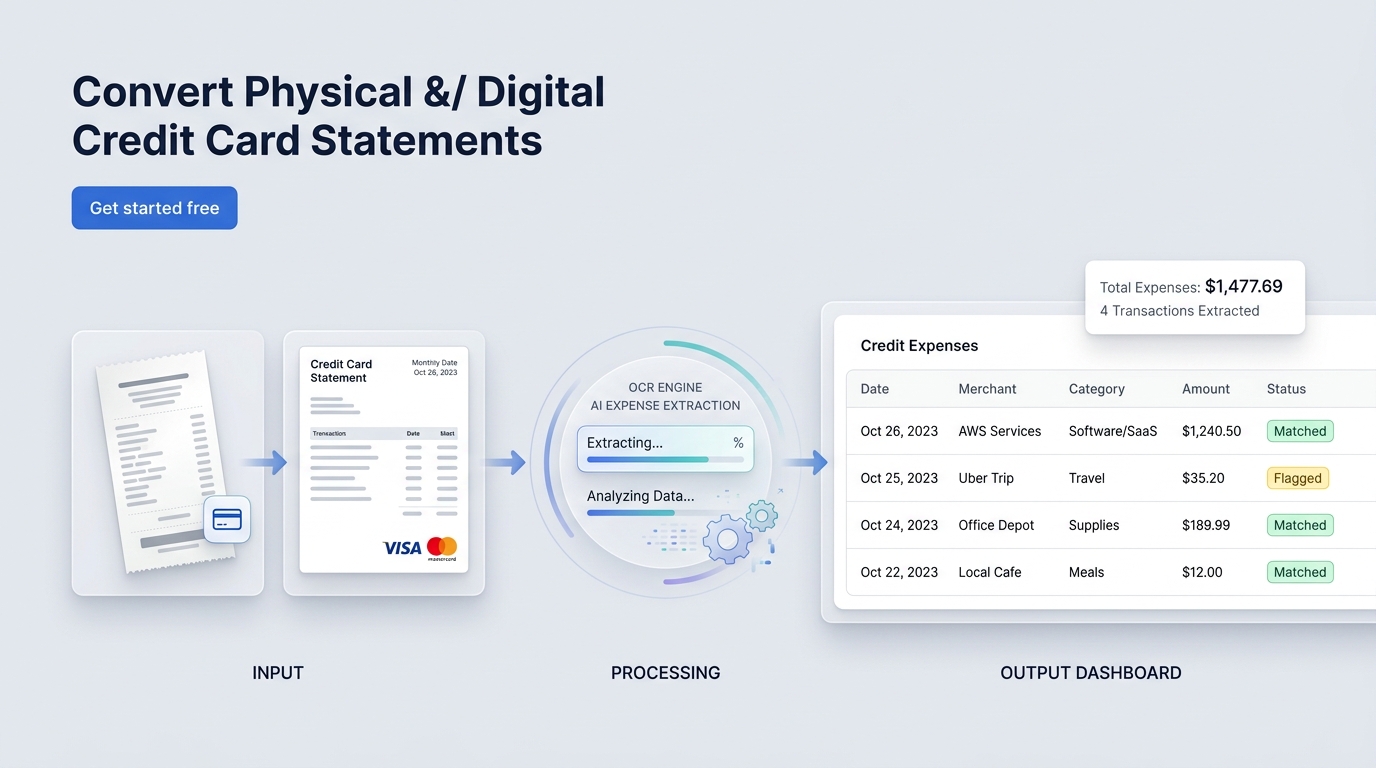
From statement PDF → expense table → categories and exports.
Quick value props
Purpose-built for expense workflows: extraction, cleanup, categorization, and export.
Works with any issuer format
Handle statement layout differences across card brands, issuers, and time periods.
Extract credit card transactions automatically
Turn statement lines into a clean expense table you can reconcile and report on.
Categorize spend (AI-assisted)
Group by merchant, vendor, expense type, or custom rules for your chart of accounts.
Handles scans and images
Credit card statement OCR that works on scans, photos, and low-quality exports.
What is a credit card statement?
A credit card statement summarizes charges, payments, and balances for a billing period. Teams use credit card statement OCR to extract transaction lines, then structure them for expense reporting, bookkeeping, audits, and tax prep. DocuClipper turns statements into tables you can use in Excel, QuickBooks, Xero, or custom workflows.
Need cash flow, income verification, or flow-of-funds analysis instead? See bank statement data extraction.
Credit card statements create expense chaos
Merchant names vary and are hard to normalize
Manual categorization is slow and inconsistent
Messy PDFs and scans break standard converters
Hard to track recurring subscriptions and vendor spend
DocuClipper turns credit card statements into expense-ready data
Extract transactions, normalize merchant names, and generate clean outputs you can import or analyze.
1
Upload statements
PDFs, scans, and images.
2
Extract expense lines
Date, merchant, amount, fees.
3
Categorize & export
Excel/CSV, summaries, or imports.
Use AI prompts to categorize and summarize spend
Extract what you need in plain English: categories, vendor groupings, recurring subscriptions, monthly totals, and more.
Invoice extraction
Paste the prompt, upload documents, and export the structured output.
Prompt
Extract vendor name, invoice number, total amount, due date.
Output (example)
| Vendor | Invoice # | Total | Due date |
|---|---|---|---|
| Acme Supplies LLC | INV-10492 | $3,218.40 | 2026-02-15 |
| Northwind Office | A-8821 | $468.00 | 2026-02-20 |
| BrightStar Freight | FRT-773 | $1,029.12 | 2026-02-28 |
Use cases (pick your workflow)
Route extracted credit card transactions into the workflow you care about most.
Credit card statement converter
Convert PDFs to Excel/CSV and structured outputs.
Open converter →
Bookkeeping automation
Standardize transactions for monthly close and reconciliations.
Financial document automation →
Invoice processing
Combine statement and invoice workflows for clean books.
Invoice processing →
QuickBooks and Xero workflows
Export and import data for your accounting system.
QuickBooks workflows →
Transaction categorization
Categorize, group by vendor, and build spend summaries.
Categorization feature →
Need bank-level analysis?
Income verification, cash flow, investigations, and more.
Bank statements hub →
Why use DocuClipper for credit card statement OCR
Manual expense tracking vs automated extraction + categorization
| Feature | DocuClipper | Manual process |
|---|---|---|
| Review & categorize expenses | Automated extraction + AI prompts | Manual cleanup |
| Accuracy | Consistent tables across formats | Missing/duplicated lines |
| Speed | Minutes per statement batch | Hours of copy/paste |
| Scaling | Bulk processing | Limited by headcount |
Social proof
“We turned credit card statements into categorized expense reports in minutes.”
Less cleanup, clearer spend reporting, and faster monthly close.
FAQ
Answers for common credit card statement OCR and expense extraction questions.
DocuClipper supports credit card statement PDFs, scanned PDFs, and images. If you can view the statement, we can typically extract the transaction lines into structured data.
Yes. DocuClipper uses credit card statement OCR to extract lines from scans and images, then structures the output into consistent columns.
Yes. You can use AI prompts to categorize spend by type, group by vendor/merchant, and generate summaries for bookkeeping, reporting, and tax prep.
Yes. Export to Excel/CSV, or route your workflow into accounting tools like QuickBooks or Xero depending on the integration you use.
Bank statements are typically used for cash flow and income analysis. Credit card statements are typically used for expense tracking and categorization. If you need bank-level analysis, see our bank statements hub page.