

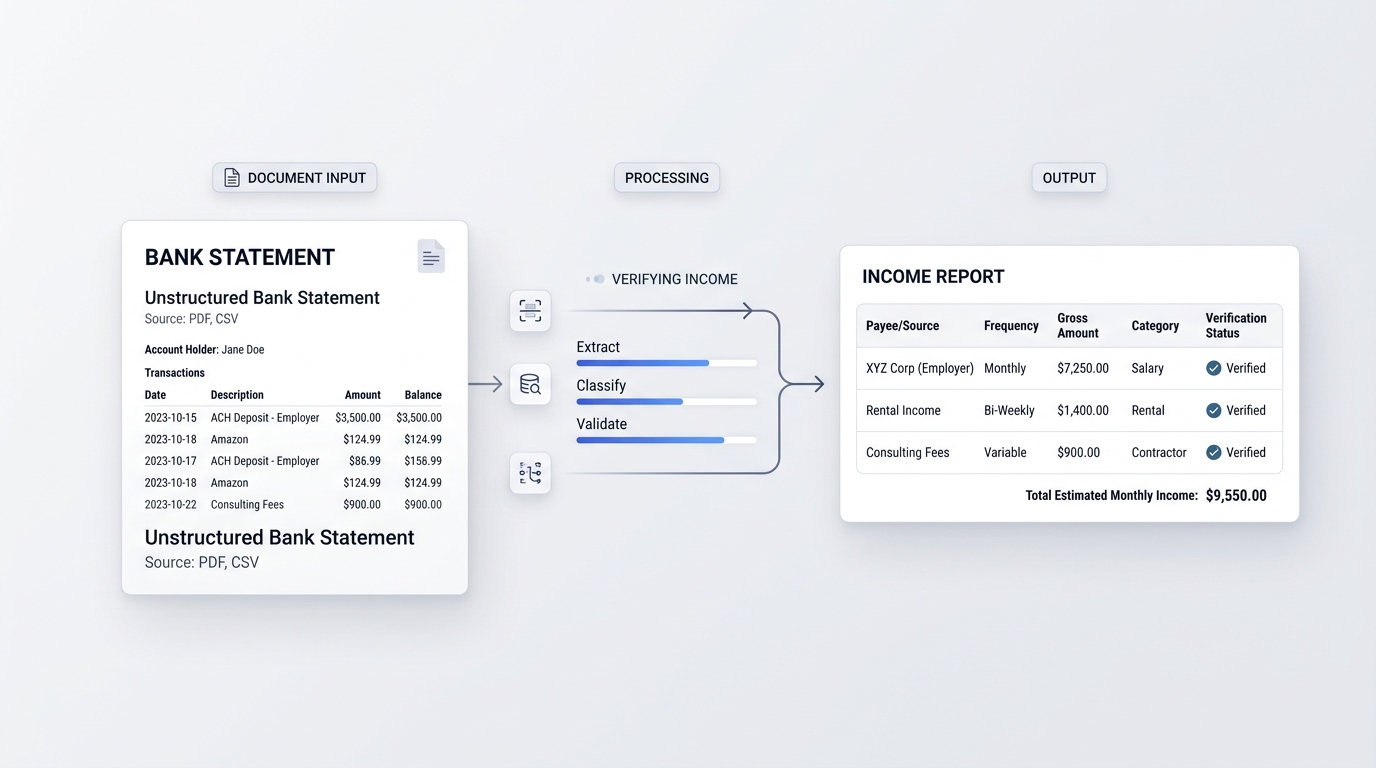
High-trust outputs for high-stakes decisions. See sample report
Built for income verification teams
80%
Less manual review time
Minutes
To generate summaries
Audit-ready
Traceability
Manual income verification is slow, inconsistent, and easy to miss
What slows teams down
- •Analysts spend hours scanning statements and calculating averages.
- •Inconsistent rules produce inconsistent decisions across reviewers.
- •Red flags get missed (NSF/overdrafts, irregular deposits, volatility).
- •High volumes create bottlenecks that slow approvals and increase cost.
How DocuClipper fixes it
- Extract structured transactions from statements automatically.
- Generate consistent monthly income summaries (avg/min/max) with trends.
- Separate income sources (payroll, gig, benefits, transfers) for cleaner review.
- Surface risk signals and anomalies with a clear audit trail.
See a sample income verification report
A clear summary for decisions, plus the transaction trail you need for QA and audits.
Monthly income summary
Average monthly income$6,420
Min / Max (6 mo)$5,120 / $7,980
Primary sourcePayroll (recurring)
Income sources
- Payroll, recurring deposits with stable cadence
- Gig income, irregular but consistent monthly presence
- Transfers, separated from “real income”
Risk flags
- NSF / overdraft activity detected
- Irregular deposit spike in one month
- Income drop greater than threshold
Everything you need for fast, reliable income verification
Purpose-built for enterprise teams that need speed, consistency, and defensible outputs.
Minutes per file, not hours
Turn multi-month bank statements into structured income summaries fast, without manual scanning, copy/paste, or spreadsheets.
Consistent income calculations
Standardize how your team computes averages, trends, and pay-period normalization so decisions are repeatable across reviewers.
Risk signals surfaced automatically
Flag NSF/overdrafts, irregular deposits, unexplained spikes, and volatility so you can focus attention where it matters.
Audit-ready traceability
Every number ties back to underlying transactions for defensible underwriting decisions and easier QA and compliance review.
Exports and API-friendly outputs
Export CSV/Excel or integrate via API to feed structured income and signals into your underwriting workflow.
AI prompts for custom rules
Define what “income” means for your policy, payroll-only, benefits, volatility thresholds, and extract exactly what you need.
Customize income verification with AI prompts
Need lender-specific rules or fields? Define them in plain English and generate structured, audit-ready outputs.
Payroll-only income (6 months)
Prompt
Extract all payroll deposits over the last 6 months. Calculate average monthly income, min, max, and provide a month-by-month table.
Volatility / drop detection
Prompt
Flag months where total income drops more than 30% compared to the previous month. Include the deposit sources contributing to the drop.
Benefits and government deposits
Prompt
Identify all government benefit deposits. Summarize total benefits per month and separate them from payroll income.
Built for lenders, property managers, and fintech
Make faster decisions while improving consistency and reducing fraud and exceptions.
Lenders & underwriting
- · Standardize income calculations
- · Reduce time-to-decision
- · Improve audit defensibility
Tenant screening
- · Verify income faster
- · Reduce fraud risk
- · Handle high volume consistently
Fintech / BNPL
- · Structured outputs for decision engines
- · Real-time validations
- · API-driven workflows
Manual review vs. automated income verification
Replace spreadsheet workflows with consistent, scalable outputs.
| Feature | DocuClipper | Manual review |
|---|---|---|
| Time to verify income | Minutes per applicant file | 1–2 hours per file |
| Consistency across reviewers | Standardized calculations and outputs | Varies by analyst and process |
| Risk signal detection | Automatic flags (NSF, overdrafts, volatility) | Easy to miss under time pressure |
| Audit defensibility | Transaction-level traceability | Manual notes and spreadsheets |
| Scale with volume | Throughput increases without headcount spikes | Limited by reviewer capacity |
What Customers Say
Real reviews from accountants, bookkeepers, and finance teams.
“DocuClipper has helped us eliminate several manual data entry processes, saving us a lot of time.”
KR
Kristin Mitchell
Accounting, United States
“It's a complete game-changer. Instead of spending hours combing through statements, we get the data we need almost instantly.”
MA
Matt
Lending, United Kingdom
“DocuClipper allowed us to enhance our advisory services, directly impacting our bottom line.”
SA
Sarah Winship
Accounting, United Kingdom
Verify income from bank statements in seconds. Start your free 14-day trial.
Start free trialIncome verification FAQs
DocuClipper extracts all transactions from bank statement PDFs, identifies recurring income deposits by amount and frequency, and generates monthly summaries showing average, minimum, and maximum income. The underlying transactions are available for review and traceability so underwriters can verify figures directly.
Yes. DocuClipper classifies deposits by source and recurrence. Payroll deposits from employers typically appear on a fixed schedule and are labeled consistently; transfers from savings accounts or other banks have different patterns. You can configure AI prompts to separate qualifying income from non-qualifying credits based on your underwriting policy.
Most lenders request 2-3 months of statements for standard income verification and 12-24 months for self-employed borrowers. DocuClipper processes any number of months in a single batch and consolidates income summaries across the full period, so underwriters see trends rather than having to compare statements manually.
Common signals include NSF fees, overdrafts, irregular deposit patterns, income volatility, large unexplained deposits, and unusual spikes or gaps. Flags are surfaced in the export alongside the transactions that triggered them. You can adapt the report to your own thresholds and alert criteria.
Yes. Use AI prompts to extract the specific fields you need and apply rules aligned with your policy, for example, payroll-only income qualification, benefit income exclusion, or flagging any month-over-month drop greater than 30%. Prompt templates are reusable across all submissions.
Yes. Export income verification summaries and transaction details as CSV or Excel for upload to your LOS. The DocuClipper API supports programmatic submission and JSON output, so lending platforms can embed verification directly into their pipeline without manual steps.