
Litigation support
How to turn years of bank records into a summary exhibit for litigation
A method for litigation-support teams and forensic accountants: get the underlying bank records in admissible form, prove the set is complete, convert every statement into one table that ties to each statement's printed balances, keep a source reference on every row, and build the Rule 1006 summary from it. Works in Excel; DocuClipper does the conversion, tie-out and coverage.
To turn years of bank records into a summary exhibit, start with records you can get admitted (usually the bank's own statements with a custodian's certification), prove the set is complete, and convert every statement into one table where each row carries its account, statement period, source document and page. Check that every statement ties to its printed opening and closing balances, pair transfers between the party's own accounts, and then build the summary (totals by payee, month, account or category, and the charts) from that table. Under Federal Rule of Evidence 1006, the underlying records must be made available to the other side, so every figure in the summary should lead back to a page they can find. State courts have their own versions of these rules.
Litigation-support work on bank records looks the same in a fraud case, a partnership dispute, a receivership or a contested divorce: a few thousand pages from several banks, produced in pieces, some scanned, and a deadline. This guide is the order to work it in so the summary holds up when the other side's expert goes looking for the weak row.
While you are here
Trace every dollar across hundreds of statements
Bank PDFs, checks, and ledgers pile up fast in investigations. DocuClipper helps teams catalog files, trace transfers between accounts, and tie checks back to statement lines without losing the thread.
What Rule 1006 requires
Federal Rule of Evidence 1006 lets the court admit "a summary, chart, or calculation offered to prove the content of voluminous admissible writings, recordings, or photographs that cannot be conveniently examined in court". In practice:
- The underlying records must be admissible. Bank statements usually qualify as business records under Rule 803(6), shown through a custodian's testimony or a certification under Rule 902(11), which requires reasonable written notice to the other side.
- The records must be available. The proponent makes the originals or duplicates available to the other parties for examination or copying at a reasonable time and place, and the court may order them produced in court.
- The summary must be accurate and fair. The 2024 committee note says a summary that does not accurately reflect the underlying records, or is argumentative, can be excluded under Rule 403. Characterizations ("suspicious transfers") belong in testimony, not in the column headers.
The amendment effective December 1, 2024 made two changes worth knowing. Rule 1006 now says a summary may be admitted "whether or not" the underlying records "have been introduced into evidence", and the committee note says a 1006 summary is substantive evidence. And a chart that only helps explain testimony is now an illustrative aid under new Rule 107, which says "an illustrative aid is not evidence" and generally keeps it out of the jury room. Many states have a summary rule modeled on 1006, but not all have adopted these changes; check yours.
The four challenges to expect
A bank records summary is usually attacked on the same four points. Build the table so each has an answer:
- "Records are missing." Show an account-by-month inventory for the whole period, and explain any gap.
- "The numbers don't match the bank." Show that every statement's transactions add up to its printed opening and closing balances.
- "You counted the same money twice." Show that transfers between the party's own accounts were paired and excluded from income and spending totals.
- "Where did this row come from?" Show the document and page for any row anyone points to, and which rows (if any) were entered or corrected by hand.
Step-by-step: from bank records to a summary exhibit
- Get the records in admissible form. Subpoena the bank when you can, with a request for a custodian certification. Log each production: date received, producing party, Bates range, file names.
- Build the inventory. One row per account, one column per month of the relevant period. Mark each statement you have. Request the gaps; note any you cannot close.
- Convert every statement into one table. Date, description, amount, running balance, account, statement period, source file and page. Keep the Bates prefix in the file name so the source travels with the row.
- Tie out every statement. Opening balance plus deposits minus withdrawals equals the closing balance; each closing balance equals the next opening balance. A statement that does not tie out usually has a missing page or a misread row; fix it before anything else.
- Remove duplicates. Productions often include the same statement twice, or overlapping periods. Keep one copy of each.
- Pair transfers. Match each withdrawal with the deposit it became in another account of the same party.
- Build the summary from the table. Totals by payee, month, account or category; check payee schedules; a flow of funds chart. Compute every figure from the tied-out table, never by retyping.
- Write the methodology note. Records used, accounts and period covered, gaps, exclusions (transfers, reversals), categories and how they were assigned, and every row entered or corrected by hand.
- Make the underlying records available. Rule 1006 requires the originals or duplicates to be available to the other parties at a reasonable time and place; making the working table available as well heads off most disputes about how the figures were built.
Where DocuClipper does each step
Create one project for the matter and upload the productions: PDFs and scans, from any bank. Duplicate files are flagged at upload.
| Step | DocuClipper |
|---|---|
| Inventory | Coverage grid: one row per account, one column per month, each cell marked reconciled, not reconciled, transactions only, or missing; missing months exported by name in a CSV |
| One table | Every statement converted into transactions, with 99.9% accuracy, across years and accounts in one project |
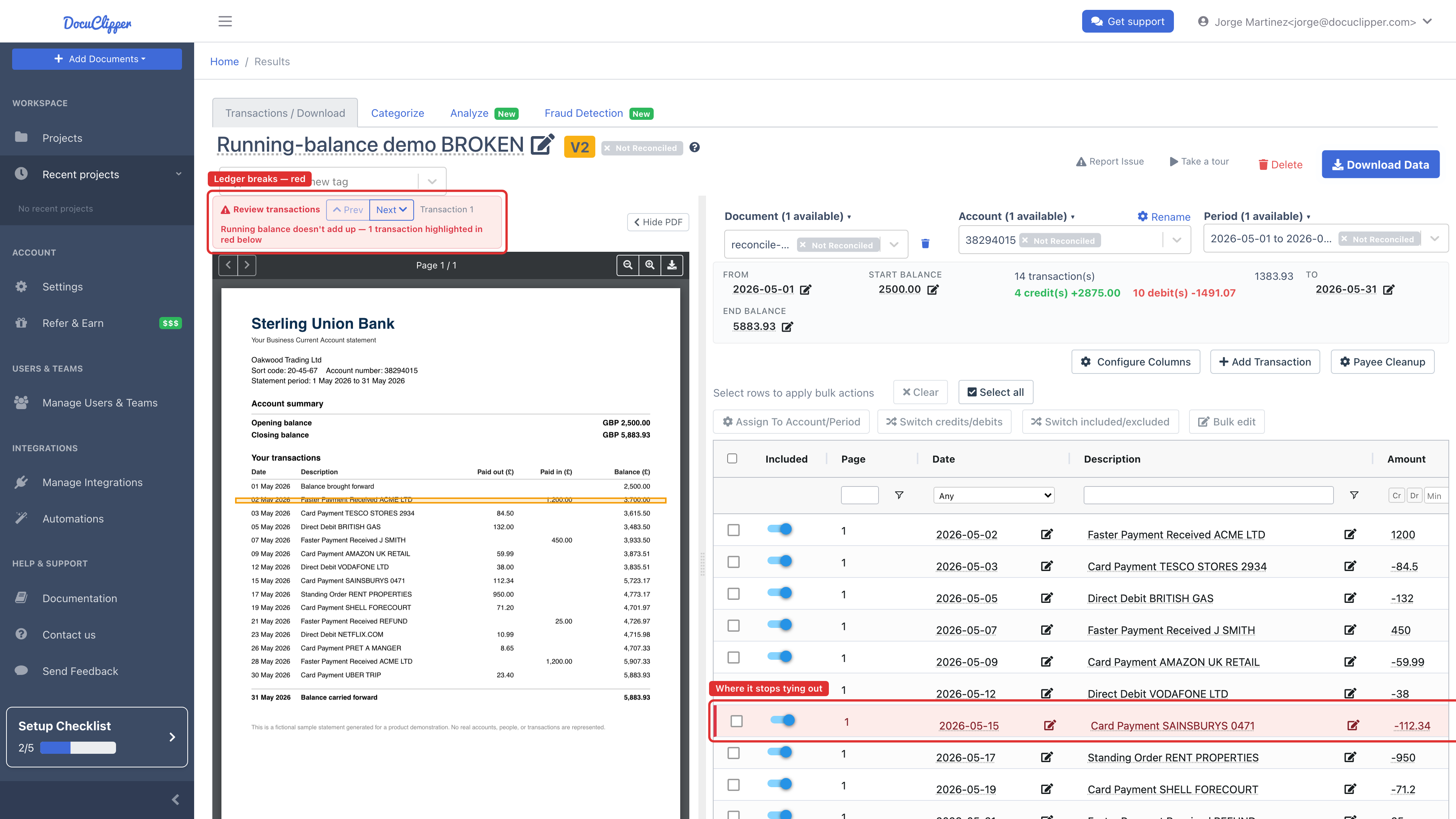
| Tie-out | Every statement checked against its printed opening and closing balances; a statement that does not tie out is flagged at the row where it breaks |
| Duplicates | Identical files flagged at upload; overlapping statement periods flagged in Coverage |
| Transfers | Transfers pairs withdrawals and deposits between accounts, for you to approve or reject |
| Source of every row | Each row shows the statement page it came from; clicking it highlights that line on the page. The Excel export can put a summary block above each statement with its source document, period, balances, totals and whether it reconciles |
| Hand corrections | Rows added by hand are marked in the transactions view, and the export's source column marks rows added or edited by hand |
| Summary and charts | Payees, categories, cashflow by month and Flow of Funds (Business and Enterprise), with Excel and multi-sheet XLSX exports |
| Report | A PDF or Excel report whose appendix lists every document with its statement period, page count and whether it reconciles, plus what was changed by hand |
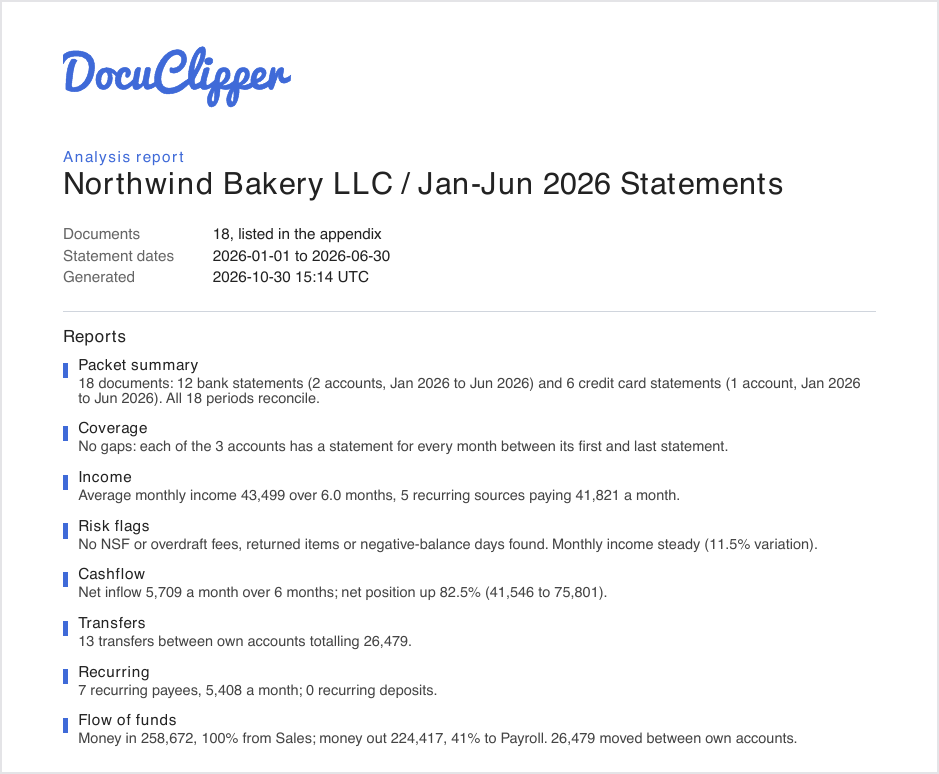
The report's cover summarizes the whole packet. Its appendix lists every statement and whether it reconciles, and every page footer names the project, so a printed copy can be traced back:
Where a statement does not tie out, the row where the running balance breaks is highlighted, so it can be fixed against the page before it reaches the summary:
Put it into practice
Structure is what makes flow-of-funds credible
When you can sort transfers and follow balances across periods, the narrative gets clearer, and answers to opposing questions come faster.
Can I do this without special software?
Yes. Many litigation-support teams still key bank records into Excel or Access by hand, or pull tables out of digital PDFs with Excel's Get Data > From PDF, Adobe Acrobat or Tabula. Scans have to be retyped. Whatever the tool, run the four checks above yourself: inventory, tie-out, transfers and a source reference on every row.
Limits
- It is not a document review platform. DocuClipper does not apply Bates numbers, review privilege or manage productions. Keep the Bates range in the file name.
- Admissibility is for the court. DocuClipper prepares and checks the data; the person sponsoring the summary explains how it was built.
- It reads only what was produced. An account no statement mentions cannot be found from the statements.
- Categories are a starting point. Review every category that appears as a total in the exhibit.
- Check your protective order. DocuClipper is a cloud service, SOC 2 Type II certified and encrypted in transit. If an order restricts where produced records may be stored, confirm before uploading.
FAQ
What is a Rule 1006 summary?
Federal Rule of Evidence 1006 lets the court admit a summary, chart or calculation offered to prove the content of voluminous admissible writings, recordings or photographs that cannot be conveniently examined in court. The proponent must make the originals or duplicates available to the other parties for examination or copying at a reasonable time and place. Since the amendment effective December 1, 2024, the rule says a summary can be admitted whether or not the underlying records have been introduced into evidence. Many states have a similar rule, with their own wording.
How do you get bank records admitted as evidence?
In federal court, bank statements are usually offered as records of a regularly conducted activity under Rule 803(6), with the foundation shown through a custodian's testimony or a certification from the bank's records custodian under Rule 902(11). A party relying on a certification must give the other side reasonable written notice before trial and make the record and certification available for inspection. Statements produced by a party rather than the bank may need a different foundation, which is one reason to subpoena the bank directly when authenticity is in doubt. State rules are similar but not identical.
How do you summarize years of bank statements?
Convert every statement into one table with the account, statement period, source document and page on every row. Check that each statement ties to its printed opening and closing balances and that no months are missing. Pair transfers between the party's own accounts so they are not counted twice. Then build the totals the case needs, by payee, month, account or category, from that table, and keep a note of what was excluded or corrected.
What makes a summary exhibit hard to challenge?
Completeness, tie-out and traceability. Every statement for the period is present or its absence is explained, every statement ties to the bank's own printed balances, transfers are not double-counted, and every figure can be traced to a specific document and page. A methodology note covering scope, exclusions and hand corrections answers most cross-examination before it starts.
Can I use software to prepare a bank records summary?
Yes, for the data preparation. Software converts the statements, checks they tie out and finds the gaps. The summary's scope, the categories, what is excluded and the testimony about how it was built remain the work of the person sponsoring it. Admissibility is decided by the court, not by any software.
Related guides
- How to trace funds across bank statements
- How to organize bank statements produced in discovery
- How to detect embezzlement in business bank statements
- How to get bank statements, including from a closed account
- Forensic accounting software
- DocuClipper for forensic accounting
Sources
- Federal Rule of Evidence 1006 (summaries to prove content), including the 2024 committee note
- Federal Rule of Evidence 107 (illustrative aids), effective December 1, 2024
- Federal Rule of Evidence 803(6) (records of a regularly conducted activity)
- Federal Rule of Evidence 902(11) (certified domestic business records)
- Federal Rules of Evidence, as amended (uscourts.gov)
This guide is general information, not legal advice.
Next step
Built for dispute, fraud, and deep-dive engagements
Less time reformatting exhibits. More time on judgment calls. See how teams run file-to-export in one workspace.