
Forensic tracing
How to trace funds across bank statements
A step-by-step tracing method for forensic accountants, litigation-support teams and family-law professionals: confirm the records are complete, put every account in one tied-out table, take out transfers between the subject's own accounts, follow each dollar to where it ended up, and apply the lowest intermediate balance rule when funds were commingled. Works in Excel; DocuClipper does the data work.
To trace funds across bank statements, start from the money you are following (its date, amount and the account it landed in), confirm you have every statement for every account from that date on, and put all the transactions into one table. Pair the transfers between the subject's own accounts so the same dollars are not followed twice, then follow each outflow to its payee, beneficiary or next account. Where the money was mixed with other funds in one account, apply a tracing rule, most often the lowest intermediate balance rule. Record every step with the statement and page it came from.
The arithmetic of a trace is rarely hard. What makes tracing slow is the record: years of statements from several banks, some scanned, a few months missing, transfers that look like income on one side and spending on the other. This guide walks the method in order, says where DocuClipper does each step, and is plain about what stays your judgment.
While you are here
Trace every dollar across hundreds of statements
Bank PDFs, checks, and ledgers pile up fast in investigations. DocuClipper helps teams catalog files, trace transfers between accounts, and tie checks back to statement lines without losing the thread.
What a tracing analysis answers
Every trace answers one of two questions:
- Where did the money go? Following a misappropriated payment, a sale's proceeds or a loan advance forward to the people and accounts that received it. Used in fraud, embezzlement, receivership and bankruptcy recovery work.
- How much of it is still here? Showing that part of today's balance, or an asset bought from an account, can be traced to a specific source. Used for separate property claims in divorce, trust and constructive-trust claims, and some bankruptcy disputes.
Write the question down before you open a statement. It decides which accounts matter, which period you need and which rule you apply at the end.
What records you need
- Every bank, savings, money market and credit card statement for each account on the path, from the starting event to the end of the trace
- Brokerage and retirement statements if the money moved into investments
- Check images (front and back) for any large check, so you can name the payee and see where it was deposited
- Wire and transfer confirmations for large outgoing items
- Closing statements, deeds or purchase documents for any asset the money bought
If a statement is missing, request it from the other side or subpoena the bank. A trace with a missing month is only as strong as the guess you make about that month.
Step-by-step: tracing funds across bank statements
- Define the starting point. The deposit, its date, amount and account. For example: a $50,000 inheritance check deposited into a joint checking account on March 3.
- Lay out every account against every month. One row per account, one column per month of the trace. Mark each statement you have. Any empty cell on the path is a gap you must close before relying on the result.
- Tie out every statement. Opening balance plus deposits minus withdrawals must equal the closing balance, and each closing balance must match the next statement's opening balance. A statement that does not tie out is usually missing a page.
- Put every transaction into one table. Date, description, amount, running balance, account, account holder, statement period, and the page each row came from. Use one sign convention: money in positive, money out negative.
- Label every account by holder and role.
Husband,Wife,Joint,Smith LLC,Subject A,Counterparty. The trace is a story about who moved money to whom, so every account needs an owner. - Pair transfers between the subject's own accounts. Match each withdrawal with the deposit it became elsewhere, by amount and date. A paired transfer moves the trace from one account to the next; it is not spending and it is not income.
- Follow money out of the accounts. For each outflow on the path, name where it went: the check payee, the wire beneficiary, the card merchant, a cash withdrawal, or a transfer to an account nobody produced. The last two are where traces most often lead.
- Apply a tracing rule where funds were commingled. If the traced money sat in an account alongside other money, you have to decide which dollars left first. See the worked example below.
- Build the tracing schedule. One row per movement: date, from, to, amount, running traced balance, and the statement and page that proves it. Add a chart for the reader who will not read the schedule.
The lowest intermediate balance rule, worked through
The lowest intermediate balance rule (LIBR) is a widely used method for commingled accounts in US trust, fraud and bankruptcy cases, and some family courts use it or a similar presumption for separate-property claims. It presumes that the account holder spent the other money first, so the traced money stays in the account as long as the balance allows. But once the balance drops below the traced amount, the traced amount drops with it, and later deposits of other money do not refill it. As the Third Circuit put it in Columbia Gas, the rule "allows trust beneficiaries to assume that trust funds are withdrawn last from a commingled account. Once trust money is removed, however, it is not replenished by subsequent deposits."
An illustrative example. A joint checking account holds $10,000 of marital money when a $50,000 inheritance is deposited:
| Date | Event | Account balance | Traced (separate) funds |
|---|---|---|---|
| Mar 3 | Inheritance deposited | $60,000 | $50,000 |
| Apr 15 | $25,000 paid toward a car | $35,000 | $35,000 |
| May 10 | $13,000 paid for a remodel | $22,000 | $22,000 |
| Jun-Dec | Paychecks deposited, bills paid | rises to $45,000 | $22,000 |
The $22,000 low point in May caps the trace. Even though the account later holds $45,000, only $22,000 of it can be traced to the inheritance under LIBR. The car and remodel payments may be traceable separately, if the facts support following the money into those assets.
Other approaches exist: pro rata allocation, first-in-first-out, and in California a family-expense (exhaustion) method that asks whether community income had been used up by family expenses when the asset was bought (See v. See). Some states also treat separate money that loses its identity in a marital account as marital: Illinois, for example, says contributed property that "loses its identity" transmutes to the receiving estate, subject to reimbursement rules (750 ILCS 5/503(c)). Rules vary by state and type of case, and which one applies is a question for counsel. Whatever the rule, it needs the same input: a complete, day-by-day account history you can defend.
Where DocuClipper does each step
Create one project for the matter and upload every statement: PDFs and scans, from any bank.
| Step | DocuClipper |
|---|---|
| Completeness | Coverage grid: every account against every month, each cell marked reconciled, not reconciled, transactions only, or missing; missing months exported by name in a CSV |
| Tie-out | Every statement checked against its printed opening and closing balances; a statement that does not tie out is flagged at the row where it breaks |
| One table | Every statement converted into transactions with 99.9% accuracy; the Accounts tab collapses many statements for one account into one account row |
| Holders and roles | Tag each account with holder, subject_role, account_type or any key of your own |
| Transfers | Transfers pairs a withdrawal with the matching deposit in another account, for you to approve or reject |
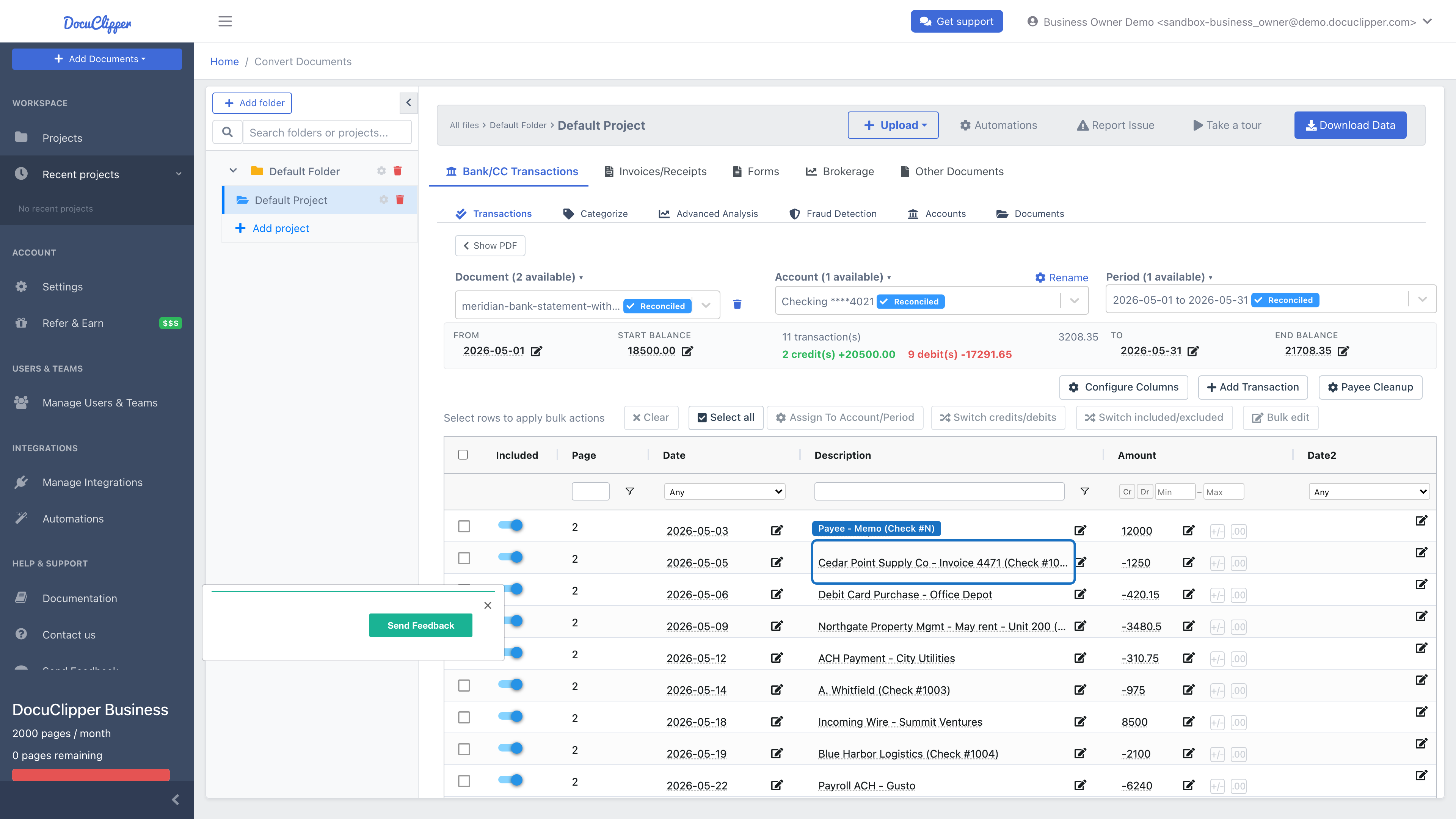
| Money out | Check payees and memos filled in from check images on the statement; accounts named in transactions but never produced listed as Referenced, not produced |
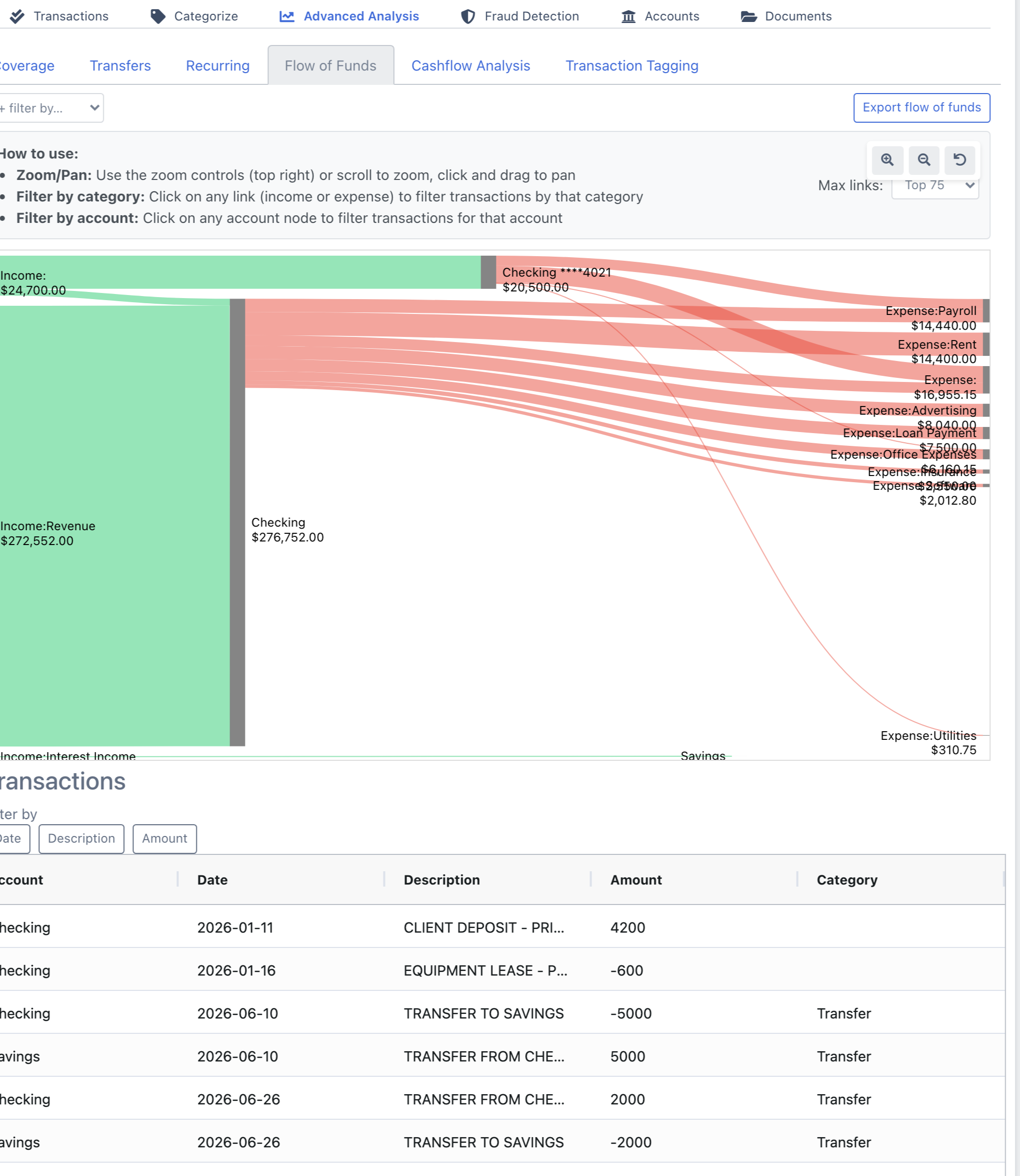
| Flow | Flow of Funds charts money between sources, accounts and destinations, filterable by holder or role, with a three-sheet XLSX export (Business and Enterprise) |
| Source of every row | Each row shows the statement page it came from; clicking it highlights that line on the page. Rows added by hand are marked as added |
Flow of Funds shows every source, account and destination on one chart, with the transactions behind any link one click away:
Each row keeps the page it came from, and check payees are filled in from the check images printed on the statement:
Put it into practice
Structure is what makes flow-of-funds credible
When you can sort transfers and follow balances across periods, the narrative gets clearer, and answers to opposing questions come faster.
Can I do this without special software?
Yes. Tracing has been done in spreadsheets for decades. Excel's Get Data > From PDF, Adobe Acrobat's export or Tabula will pull tables from many digital PDFs; scans need to be retyped or run through a separate tool. Expect each bank's layout to come out differently, tie out every statement yourself, and build the transfer matching with lookup formulas. For a two-account, one-year trace that is a day or two of work. For five accounts over four years, the data preparation is most of the engagement.
Limits
- It follows the records, not the intent. DocuClipper shows where money moved. Whether a payment was a gift, a loan, a business expense or a diversion is your call, and the rule you apply to commingled funds is a legal question.
- It does not calculate LIBR for you. The table, running balances and transfer pairs are there; the traced-balance column is yours to compute, in the export or in your own workpaper.
- It reads only the statements you have. An account no statement mentions cannot be found from the statements, and cash that never touched a bank is invisible.
- Transfer pairing is a suggestion. Two transfers of the same amount on nearby dates can be paired wrongly. Each pair can be approved or rejected.
- Check your protective order. DocuClipper is a cloud service, SOC 2 Type II certified and encrypted in transit. If an order restricts where produced records may be stored, confirm before uploading.
FAQ
How do you trace funds across bank accounts?
Start from the money you want to follow: its date, amount and the account it landed in. Get every statement for every account from that date forward and confirm none are missing. Put all transactions in one table, pair transfers between the subject's own accounts, and follow each outflow to its payee, beneficiary or the next account. Where the money was mixed with other funds, apply a tracing rule such as the lowest intermediate balance rule. Record each step with the statement and page it came from.
What is the lowest intermediate balance rule?
A tracing rule for commingled accounts. It presumes that withdrawals come from the untraced money first, so the traced funds stay in the account as long as the balance allows. The traced amount can never be more than the lowest balance the account reached between the deposit and the date you trace to, and later deposits of other money do not refill it.
What is a tracing analysis in forensic accounting?
A reconstruction of how specific funds moved, built from bank and other financial records. It is used in fraud and embezzlement cases, bankruptcy and receivership recoveries, trust disputes, and divorces where one spouse claims an asset is separate property. The output is a schedule and often a chart showing each movement and the document that proves it.
How do you trace separate property in a divorce?
Show the separate money's source (an inheritance, a gift, pre-marriage savings), then follow it through every account it touched to the asset it ended up in. If it was deposited into a joint account and mixed with marital money, the result depends on state law: some states treat separate money that loses its identity in a marital account as marital, and others let it be traced with a method such as the lowest intermediate balance rule or, in California, by showing that community income was used up by family expenses when the asset was bought. Without complete statements for the whole path, the trace usually fails.
Can software trace funds automatically?
Software does the data work: converting statements, checking they are complete and tie out, pairing transfers between accounts and charting the flows. Deciding which money is the traced money, which rule applies and what the result means stays with the analyst. DocuClipper handles the data work and leaves those judgments to you.
How far back can you trace bank transactions?
As far back as you have statements. Federal recordkeeping rules require US banks to keep account statements and records of most checks and deposits over $100 for five years, and statements for closed accounts can usually still be requested or subpoenaed within that window. The practical limit is completeness: a trace needs every statement on the path, not just some of them.
Related guides
- Dissipation of marital assets: how to prove it from bank statements
- How to turn years of bank records into a summary exhibit for litigation
- How to detect embezzlement in business bank statements
- How to organize bank statements produced in discovery
- Flow of funds analysis
- Forensic accounting software
Sources
- Lowest intermediate balance rule: In re Columbia Gas Systems Inc., 997 F.2d 1039 (3d Cir. 1993), citing Restatement (Second) of Trusts § 202 cmt. j (opinion)
- Family-expense (exhaustion) method in California: See v. See, 64 Cal. 2d 778 (1966) (opinion)
- Commingled marital and non-marital property in Illinois: 750 ILCS 5/503(c)
- Bank record retention: 31 CFR 1020.410 and 31 CFR 1010.430(d)
This guide is general information, not legal advice.
Next step
Built for dispute, fraud, and deep-dive engagements
Less time reformatting exhibits. More time on judgment calls. See how teams run file-to-export in one workspace.