
Forensic accounting software
From a box of statements to finished schedules: 10 forensic accounting tools compared
Which tool gets the transactions out of subpoenaed statements, traces the money, tests the ledger and charts the links? Ten tools compared on what they do and what they cost (checked October 15, 2026), plus what 21,633 statements from forensic firms on DocuClipper show about the files you will actually get.
Forensic accounting software is any tool that helps you turn financial records into evidence: extract the transactions, trace where money went, test the books for anomalies, and present the result. No single product does all of it well, so most forensic practices run a small stack: one tool to get clean transactions out of bank statements, one to analyze ledgers, and Excel (plus a charting tool for big cases) to build the exhibits.
This guide groups the tools by the job they do, compares ten of them on features and published pricing, and says where each one fits. Every competitor fact below comes from that vendor's own public website, checked on October 15, 2026; where a vendor does not publish pricing, we say so instead of guessing.
While you are here
Trace every dollar across hundreds of statements
Bank PDFs, checks, and ledgers pile up fast in investigations. DocuClipper helps teams catalog files, trace transfers between accounts, and tie checks back to statement lines without losing the thread.
What software do forensic accountants use?
Forensic work breaks into four jobs. Pick a tool for each job you actually have.
| Job | What the software does | Tools in this guide |
|---|---|---|
| 1. Statement capture | Turns PDF and scanned bank, credit card, and check records into transaction rows, and checks them against the printed balances | DocuClipper, Valid8 Financial, CounselPro, MoneyThumb |
| 2. Tracing and case analysis | Matches transfers between accounts, finds missing periods, follows funds from source to use, builds the case report | Valid8 Financial, CounselPro, DocuClipper, FraudFindr, Thrive Financial |
| 3. Ledger analytics | Full-population tests on general ledgers and ERP exports: duplicates, gaps, outliers, scripted tests | Caseware IDEA, Diligent ACL Analytics |
| 4. Link analysis | Charts people, entities, accounts and events, and shows the timeline | i2 Analyst's Notebook |
Excel sits under all four. Most forensic deliverables still end as a workbook, so whatever you buy should export clean, sortable data, not just a dashboard.
The 10 tools at a glance
Pricing is what each vendor publishes on its own site, checked October 15, 2026.
| Tool | Best for | Published pricing |
|---|---|---|
| DocuClipper | Self-serve statement extraction with per-period tie-out, transfers, gaps and flow of funds | From $29/month; flow-of-funds tracing from $159/month (Business) |
| Valid8 Financial | Verified, source-linked evidence for large investigations and agencies | Not published (demo) |
| CounselPro | Law firms that want extraction, tracing and a written report in one tool | $100, $250 or $500/month, or $499 per case |
| MoneyThumb | Statement conversion with PDF fraud detection on server plans | PDF Server plans from $599.95/year |
| FraudFindr | Financial exploitation cases for agencies, attorneys and payees | Not published (demo) |
| Thrive Financial | Divorce matters, from discovery to settlement | Free; $149 per case; $299 or $499 per user/month |
| Ocrolus | Lenders that also handle legal or Medicaid files | Not published (demo) |
| Caseware IDEA | Full-population testing of ledgers and accounting exports | Not published (demo) |
| Diligent ACL Analytics | Audit, risk and compliance teams running scripted tests | Not published; 30-day free trial |
| i2 Analyst's Notebook | Link charts and timelines for large fraud and crime investigations | Not published (subscription plans) |
What forensic statement files actually look like
Before comparing features, it helps to know what you will be feeding them. We looked at the bank and credit card statements uploaded to DocuClipper over the last 180 days by forensic, litigation-support and fraud-investigation firms (identified by firm name and email domain; mid-October 2026).
- Volume: 21,633 statements, 183,008 pages.
- Scans: 26% were scanned or image-only PDFs, not digital downloads. Subpoena returns and client boxes are rarely clean bank downloads.
- Age: 55% of statements ended more than a year before they were uploaded, and 24% more than three years before. Old layouts and closed accounts are the norm, not the exception.
- Matter size: in matters organized as projects, the median holds 12 statements; the largest 10% hold about 145 or more. 39% span two or more accounts, and the median matter covers about two years of activity (the largest 10%, almost seven).
- Tie-out: 71% of 38,463 statement periods reconciled automatically to the bank's printed opening and closing balances: 76% on digital PDFs and 61% on scans. The rest were flagged for review rather than passed as clean.
That last number is the one to ask every vendor about. On forensic files a good share of periods will not tie out on the first pass: a missing page, a faded scan, a statement that does not print its balances. Software that checks each period and tells you which ones failed lets you spend review time where it is needed. Software that only reports a confidence score leaves you to find the problems yourself, possibly on the stand.
How to choose forensic accounting software
Questions worth asking in a demo or a trial, in roughly this order:
- Does it check every statement period against the printed balances, and show you the ones that fail? Ask what happens to a period that does not tie out.
- How does it handle scans and old statements? Try your worst file: a faxed or photocopied statement from a closed account.
- Does it find missing statements? Gaps in a production are often the finding. You want a per-account, per-month view of what is missing.
- Can it match transfers between accounts and flag accounts that are referenced but not produced?
- Can you trace any number back to the page it came from? Every row in an exhibit should lead back to its source document.
- What does the export look like? You will rebuild the analysis in Excel for the report; check the columns before you buy.
- How does the price scale? Per page, per credit, per case, or per seat changes the cost of a 1,500-page matter a lot.
- Security: where data is stored, who can access it, and whether the vendor has a current SOC 2 report.
How we evaluated
Disclosure: DocuClipper publishes this guide and is one of the forensic accounting tools ranked, and we placed it first. Weigh the ranking with that in mind. The criteria below are the ones we used, so you can check every placement yourself.
We compared each tool on what its own website, documentation and pricing page state. These follow the questions in how to choose forensic accounting software above:
- Tie-out: whether each statement period is checked against its printed balances and failures are shown, not hidden.
- Gaps and transfers: whether missing statements are reported and transfers between accounts are matched.
- Traceability: whether every row leads back to its source page.
- Exports: whether the output is usable for an exhibit or expert report.
- Pricing: published or not, and how it scales on a large matter.
We did not run a side-by-side accuracy test of every tool. Where an accuracy figure appears, it is the vendor's own published claim, DocuClipper's 99.9% included.
How to check this yourself
- Take a real (or sanitized) production: several accounts, a few years, at least one poor scan.
- Run it through the trials on your shortlist.
- Check which statement periods tie to their printed opening and closing balances, whether missing months are reported, and whether transfers between the accounts are matched.
- Trace three numbers in the output back to the page they came from, then check the export columns against the exhibit you need to build.
1. DocuClipper
What it is: DocuClipper extracts transactions from bank, credit card and brokerage statements (digital PDFs and scans) and checks each statement period against the bank's printed balances. Forensic firms use it for the capture-and-tracing part of the job; see how it fits a forensic accounting practice.
What it does for forensic work:
- Every statement balanced, or flagged. Each statement is checked against its printed opening and closing balances, and the review screen points to the first row where the running balance stops matching, next to the PDF page it came from.
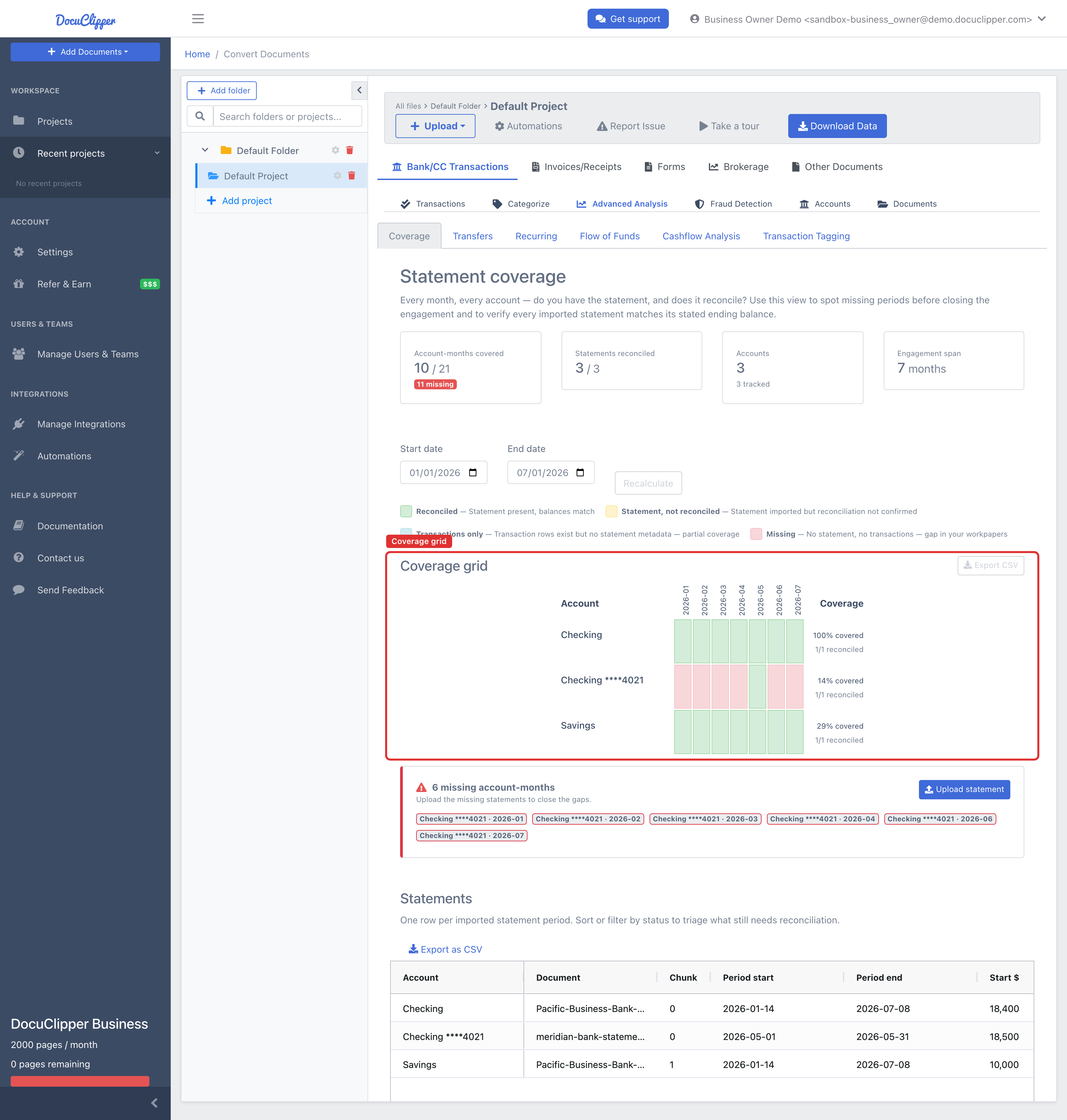
- Coverage (date gaps). A month-by-account grid shows which statements you have, which reconcile, and which are missing, with a CSV export for your document request. See date gaps analysis.
- Undisclosed accounts. Account numbers that the statements reference but that were never produced are flagged with the transactions that name them. See finding undisclosed accounts.
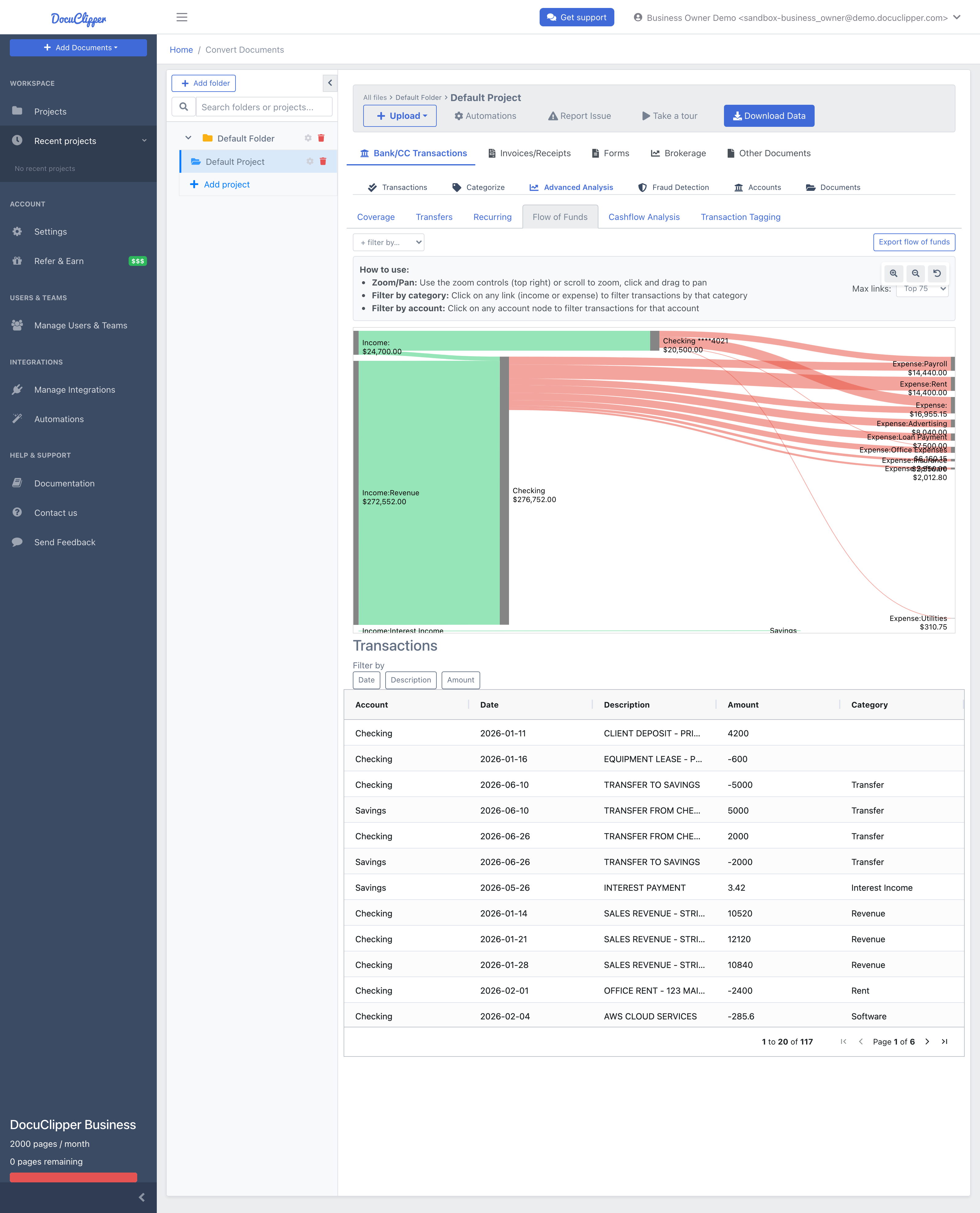
- Transfers and flow of funds. Transfers between accounts are matched as debit/credit pairs; the Flow of Funds view traces money between account holders, and exports a workbook with every transaction, the account-to-account totals, and per-account totals. See multi-account tracing.
- Duplicates and checks. Duplicate statements and overlapping transactions are caught; check images on statements fill in payee and memo.
- Fraud signals on the documents themselves. The bank statement analyzer scores each statement for signs of editing (the PDF's edit history, its layout, the balance arithmetic) and lists each signal it found.
- Export to Excel, CSV, QuickBooks and Xero.
Limits: DocuClipper works from statements, not general ledgers or ERP exports, so it does not replace IDEA or ACL for ledger testing. It does not draw entity link charts, manage cases, or write the report. Account holder and role tags are entered by you. Scans balance on their own less often than digital PDFs (61% vs 76% of statements on forensic files), so plan review time for scanned productions.
Security: SOC 2 Type II.
Pricing (pricing page): monthly plans by page volume, unlimited users on every plan.
- Starter: $29/month for 60 pages, $39 for 120, $79 for 300.
- Business: $159/month for 640 pages, $219 for 1,000, $299 for 1,500. Flow of Funds, multi-account tracing and transaction tagging start here.
- Enterprise: $399/month for 1,800 pages, up to $899 for 5,000.
- Annual billing saves 30%; 14-day free trial.
See the forensic accounting software page for the full workflow, including how transaction tracing works.
2. Valid8 Financial
What it is: Valid8 Financial calls its product "Verified Financial Intelligence": it extracts, verifies, analyzes and visualizes financial data for investigations.
Features named on its site: reads bank statements, checks, wires and ledgers without templates, including handwritten checks and low-quality scans; extracts from 30+ accounting and ERP systems; balance-checks each statement and flags periods that do not tally, including missing pages; Transfer Match, Check Image Match and Cash Match; flow-of-funds tracing and a "Ledger Trace" from general-ledger entry to bank line; one click from a line to its source page; Excel and PDF exports. Lists SOC 2 Type II, HIPAA and TX-RAMP, with FedRAMP in process.
Best for: forensic investigations, expert witness work, bankruptcy and family law, and government agencies that want verified, source-linked evidence at scale, including ledger-to-bank tracing.
Pricing: not published; demo only.
Comparing the two? See DocuClipper vs Valid8 Financial.
3. CounselPro
What it is: CounselPro is aimed at law firms: it pulls transactions from bank and credit card statements, categorizes them, and on higher plans adds AI case questions, account-to-account tracing and a written forensic report.
Pricing (pricing page), in credits (1 credit per bank, credit card or check page; 2 per brokerage or tax page):
- Core: $100/month, 1,000 credits, extraction, categorization, links to statement pages, dashboard and Excel export.
- Plus: $250/month, adds AI case questions, account-to-account money tracing and a written forensic report.
- Premier: $500/month, adds checking every statement month against the bank's totals and re-reading pages that come up short.
- Single Project: $499 per case, one time, all features, starting at 1,000 credits.
Note that on its page, checking each statement month against the bank's totals is a Premier feature. CounselPro also publishes a buyer's guide to the category; it ranks its own product first.
See DocuClipper vs CounselPro.
4. MoneyThumb
What it is: MoneyThumb converts PDF statements to spreadsheet and accounting formats. Its Thumbprint product is described as "patented PDF fraud detection software" and is included in its PDF Server, PDF Insights and Enterprise plans.
Pricing (pricing page): those plans start at $599.95 per year, with volume pricing on conversions. Desktop PDF+ licenses are listed without prices and are Windows only.
Best for: teams that mainly need statement conversion and already do the analysis elsewhere. See DocuClipper vs MoneyThumb.
Put it into practice
Structure is what makes flow-of-funds credible
When you can sort transfers and follow balances across periods, the narrative gets clearer, and answers to opposing questions come faster.
5. FraudFindr
What it is: FraudFindr, now offered through The Bonadio Group, is a cloud tool for financial exploitation cases: it categorizes transactions and flags suspicious or missing activity.
Features named on its page: connect bank accounts or upload PDF or CSV statements; questionnaires to collect victim and suspect information; automatic flagging of suspicious transactions; court-ready reports with customizable sections; a case dashboard; data stored and encrypted on Google Cloud Platform.
Best for: law enforcement, adult protective services, elder-law and divorce attorneys, and representative payees working exploitation cases.
Pricing: not published; plans are tied to active users, cases and a monthly OCR page limit. Demo or contact.
See DocuClipper vs FraudFindr.
6. Thrive Financial
What it is: Thrive Financial is forensic analysis software for divorce: a document parser, a "Marital Estate Command Center", AI reports with red-flag rollups and transfer tracing, a discovery tracker, settlement modeling, and source-linked exhibits with an audit log.
Data storage: its site says it keeps no hosted case-data database; matter data lives locally in the browser until you export or share it.
Pricing (pricing page): Starter free (3 AI credits); Personal Case $149 one time; Personal Plus $29/month; Professional $299 per user per month; Small Firm $499 per user per month; Enterprise custom. Parses cost 1 to 5 credits depending on page count.
Best for: family-law teams and spouses who want one workflow from discovery to settlement. See DocuClipper vs Thrive Financial.
7. Ocrolus
What it is: Ocrolus is document automation built mainly for lenders: small business funding, mortgage, auto and consumer lending. Its site also lists legal, Medicaid and tax use cases, and fraud detection for fake documents and data inconsistencies.
Pricing: not published on its pricing page; demo or sign-up.
Best for: lenders and Medicaid look-back teams already in the lending workflow, rather than litigation-support practices. See DocuClipper vs Ocrolus.
8. Caseware IDEA
What it is: Caseware IDEA is audit data analytics: "full-population testing, anomaly detection and audit evidence." It imports from Excel, CSV, PDFs, 50+ accounting systems and Caseware Working Papers without changing the source files.
Features named on its site: pinpoint outliers, gaps and duplicates before sampling; SmartAnalyzer and custom routines; scheduled scripts; dashboards; export to Excel, Power BI or Tableau.
Pricing: not published; demo.
Best for: testing a company's general ledger, payables, payroll or vendor master in full. Pair it with a statement tool when the evidence is bank records rather than books.
9. Diligent ACL Analytics
What it is: Diligent ACL Analytics (formerly ACL, later Galvanize) is no-code analytics for audit, risk and compliance teams: natural-language prompts, existing ACL scripts, logging of every test and result, scheduled "robots", and 100+ data connectors.
Pricing: not published; 30-day free trial.
Best for: in-house audit and investigations teams that run repeatable tests on company data.
10. i2 Analyst's Notebook
What it is: i2 Analyst's Notebook is visual analysis for investigators: link charts of people, entities and events, social network analysis to find intermediaries, and timelines. Its site says more than 2,000 organizations use it, across law enforcement, government, and banking and finance.
Pricing: not published; sold as Core, Collaborate, Connect and Pro subscriptions.
Best for: large fraud, money-laundering and organized-crime matters where the relationships are the story. You still need clean transaction data to feed it.
Recommended stacks by practice type
- Solo or small forensic practice (divorce, partnership disputes, embezzlement): a statement tool with tie-out, gap detection and tracing, plus Excel. DocuClipper Business, CounselPro, or Thrive Financial for divorce-only work.
- Litigation support and expert witness work at scale: Valid8 Financial or DocuClipper for statements, Caseware IDEA for the ledger side, i2 for link charts on the largest matters.
- Financial exploitation and protective services: FraudFindr, or a statement tool plus a report template.
- Corporate investigations and internal audit: IDEA or ACL Analytics on the books, with a statement tool for bank records the company does not hold.
FAQ
What is the best forensic accounting software?
It depends on the job. For getting transactions out of bank statements and tracing funds, look at DocuClipper, Valid8 Financial and CounselPro. For testing ledgers, Caseware IDEA or Diligent ACL Analytics. For link charts, i2 Analyst's Notebook. For divorce-only practices, Thrive Financial. Most firms combine two of these with Excel.
What software do forensic accountants use?
A statement extraction tool to digitize bank and credit card records, Excel for analysis and exhibits, a data analytics tool such as IDEA or ACL for ledgers, and, on large cases, a link-analysis tool such as i2 Analyst's Notebook. Case-specific platforms such as FraudFindr and Thrive Financial combine several of these for one kind of matter.
How much does forensic accounting software cost?
Published prices, checked October 15, 2026: DocuClipper from $29/month ($159/month for flow-of-funds tracing); CounselPro $100 to $500/month or $499 per case; Thrive Financial from $149 per case or $299 per user/month; MoneyThumb's PDF Server plans from $599.95/year. Valid8 Financial, FraudFindr, Ocrolus, Caseware IDEA, Diligent ACL Analytics and i2 Analyst's Notebook quote on request.
Can forensic accounting software read scanned bank statements?
Most statement tools in this guide read scans, but accuracy drops on faint, skewed or faxed pages. On forensic files uploaded to DocuClipper, 61% of scanned statement periods reconciled automatically to the printed balances, against 76% of digital ones. Use a tool that tells you which periods did not tie out so you know where to look.
Is Excel enough for forensic accounting?
Excel is still where most reports are built, but typing in transactions from PDFs is slow and error-prone on anything larger than a few statements. A typical matter on DocuClipper holds 12 statements and the largest hold well over 100, which is where extraction, per-period tie-out and gap detection save the most time.
Does DocuClipper replace a forensic accountant?
No. It does the extraction, tie-out, gap and transfer work so the accountant can spend time on judgment: what the movements mean, which ones matter, and how to present them.
Related reading
Next step
Built for dispute, fraud, and deep-dive engagements
Less time reformatting exhibits. More time on judgment calls. See how teams run file-to-export in one workspace.