
Family law financial analysis
Dissipation of marital assets: what it is and how to prove it from bank statements
What counts as dissipation of marital assets, what courts usually look for, and a step-by-step method to prove it from bank and credit card statements: pick the window, set the household's normal spending, isolate the suspect items and build a schedule where every figure traces to a statement page. Works in Excel; DocuClipper does the data work.
Dissipation of marital assets is one spouse using marital money for their own benefit, for a purpose unrelated to the marriage, usually after the marriage began to break down: gambling, spending on an affair, gifts to a new partner, unexplained cash, or money moved into accounts the other spouse does not know about. To prove it, you need every bank and credit card statement for the period, a measure of the household's normal spending before the breakdown, and a schedule that lists each suspect item with its date, amount, payee and the statement page it came from. Courts often charge the proven amount against the spending spouse's share of the marital estate. The rules differ by state.
Dissipation claims succeed on detail. "He spent a fortune at the casino" goes nowhere; "47 casino and online-betting charges between March 2024 and February 2025, totalling $63,410, every one on the joint account statements listed in Exhibit 12" does. This guide is the method for getting from a stack of statements to that schedule. It is general information, not legal advice; the law of dissipation differs by state.
While you are here
Trace every dollar across hundreds of statements
Bank PDFs, checks, and ledgers pile up fast in investigations. DocuClipper helps teams catalog files, trace transfers between accounts, and tie checks back to statement lines without losing the thread.
What counts as dissipation
Courts generally look at three things:
- Whose benefit. The spending benefited one spouse alone, or a third party, not the family.
- What purpose. The purpose was unrelated to the marriage. Paying the mortgage, the children's costs or ordinary living expenses is not dissipation.
- When. The spending happened while the marriage was breaking down, or in anticipation of divorce. The Illinois Supreme Court, for example, defines dissipation as the "use of marital property for the sole benefit of one of the spouses for a purpose unrelated to the marriage at a time that the marriage is undergoing an irreconcilable breakdown" (In re Marriage of O'Neill, 1990). Other states define it differently, and some do not tie it to the breakdown.
Typical items:
- Gambling losses, at casinos, online sportsbooks and gaming sites
- Spending on an affair: hotels, travel, restaurants, gifts, rent or bills paid for a partner
- Gifts or "loans" to relatives or friends with no record of repayment
- Large or frequent cash withdrawals with no explanation
- Transfers to accounts the other spouse did not know about, or that were never disclosed
- Selling or giving away marital property for less than its value
- Deliberately destroying or wasting marital property
Some states use other words: New York's equitable distribution factors include "the wasteful dissipation of assets by either spouse" and transfers "made in contemplation of a matrimonial action without fair consideration". Some states also set procedural rules. Illinois, for example, requires a notice of intent to claim dissipation no later than 60 days before trial or 30 days after discovery closes, whichever is later. The notice must give, at a minimum, when the marriage began undergoing an irretrievable breakdown, the property dissipated and when the dissipation occurred. And no dissipation is deemed to have occurred more than 3 years after the claiming spouse knew or should have known of it, or in any event more than 5 years before the petition was filed. Check your state's statute and case law before building the schedule.
What records you need
- Every checking, savings and money market statement for each spouse, alone and jointly
- Every credit card statement, including cards in one spouse's name only
- Business account statements for any business either spouse controls
- Brokerage, retirement and crypto exchange statements
- Check images for large checks, and wire details for large transfers
- Statements for a full year before the suspected breakdown, so you have a baseline
Step-by-step: proving dissipation from bank statements
- Set the window. Pin down when the marriage started to break down (a separation, a filing, a move out, a discovered affair) and any look-back limit in your state. Request statements for every account from at least 12 months before that date to the present.
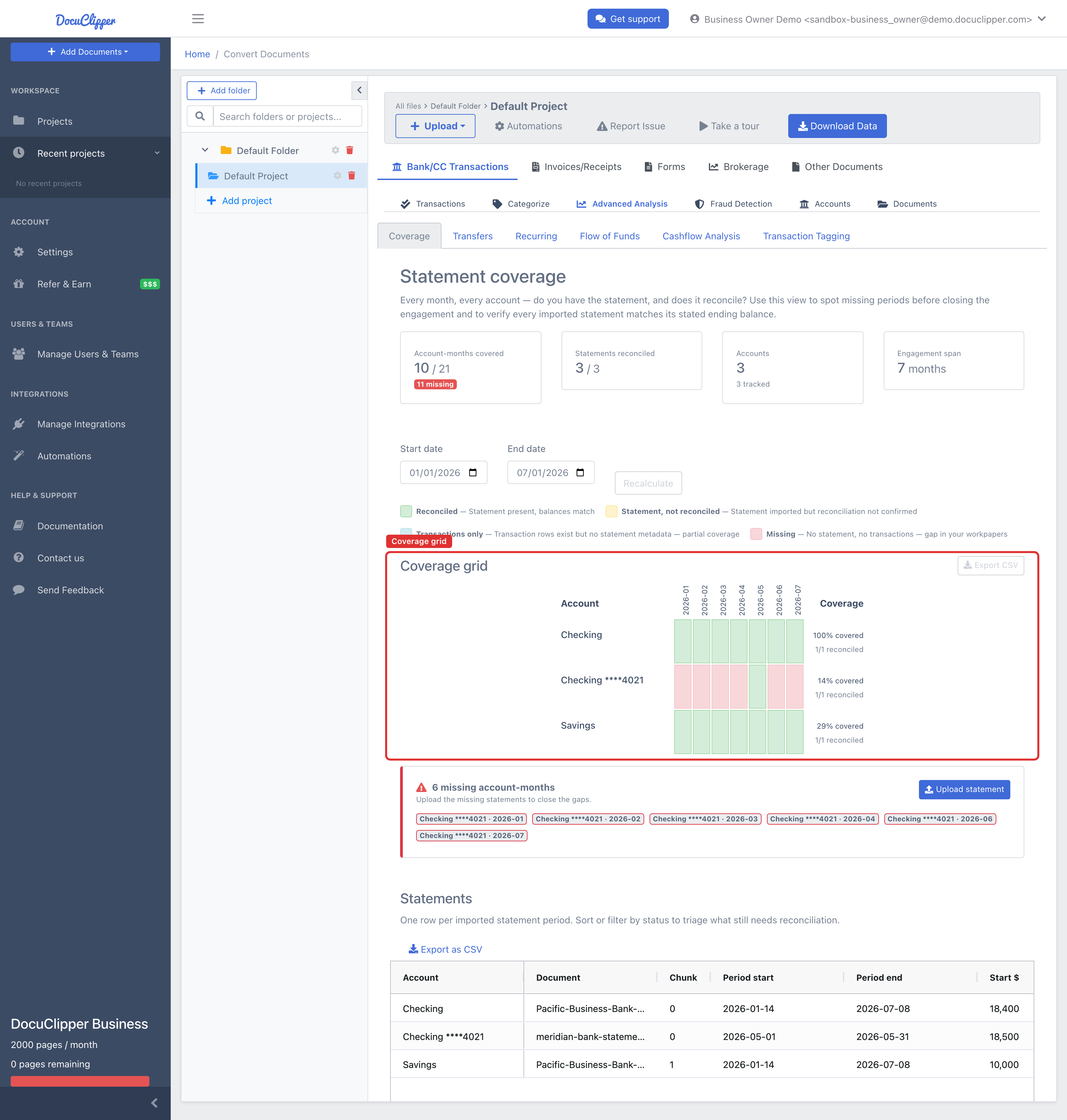
- Check the records are complete. One row per account, one column per month. Mark each statement you have, and check each one ties to its printed opening and closing balances. Missing months and accounts that the transactions mention but nobody produced go into the deficiency letter.
- Put every transaction into one table. Date, description, amount, account, whose account it is, and the statement and page each row came from.
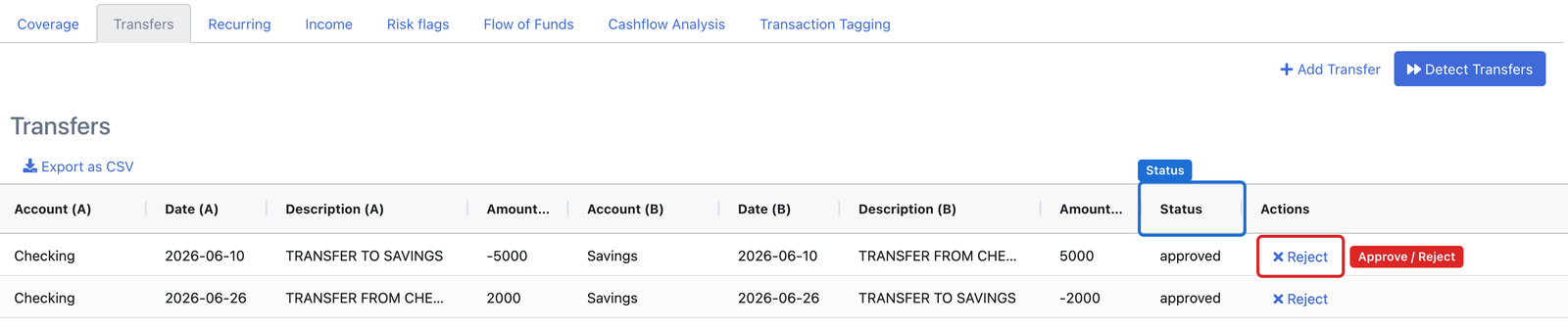
- Pair and set aside transfers between the couple's own accounts. Moving $5,000 from checking to savings is not spending. A transfer to an account that was never produced is a different matter: it goes on the suspect list.
- Measure normal household spending. Categorize the 12 months before the breakdown and average each category by month. This is the baseline the court will compare against, and it protects the claim from the answer "that was just our normal spending".
- Isolate the suspect items. Filter the period after the breakdown for gambling merchants, hotels and travel, jewelry and gift merchants, payments to a named third party, cash withdrawals, checks to individuals and transfers to unproduced accounts. Compare each category's monthly average with the baseline.
- Build the schedule. One row per item: date, amount, payee or merchant, account, category, why it is unrelated to the marriage, and the statement page. Total by category and by month.
- Serve the notice and present the schedule. Give whatever notice your state requires, by its deadline and with the contents it asks for. Keep the source statements available so the other side and the court can check every row.
An illustrative schedule summary, comparing the 12 months before the breakdown with the 12 months after:
| Category | Before, per month | After, per month | Items | Total |
|---|---|---|---|---|
| Casino and betting | $40 | $5,280 | 47 | $63,410 |
| Non-family travel | $0 | $1,150 | 18 | $13,800 |
| Transfers to unproduced ****8833 | $0 | $2,000 | 12 | $24,000 |
| Cash over $500 | $120 | $1,900 | 31 | $22,800 |
In some states the burden then moves to the spending spouse. In Illinois, once it is shown that one spouse spent down marital assets, "the party charged with dissipation must establish by clear and specific evidence how the funds were spent", and "general and vague statements" that the money went to marital expenses or bills are not enough (In re Marriage of Partyka, 1987). A precise schedule is what puts that question to the other side.
Where DocuClipper does each step
Create one project for the case and upload every statement produced: PDFs and scans, from any bank.
| Step | DocuClipper |
|---|---|
| Completeness | Coverage grid: every account against every month, each statement marked reconciled or not; missing months exported by name in a CSV for the deficiency letter |
| Unproduced accounts | Accounts named in transactions that you hold no statement for, listed as Referenced, not produced with every transaction that names them |
| One table | Every statement converted into transactions with 99.9% accuracy, and checked against its printed opening and closing balances |
| Transfers | Transfers pairs a withdrawal with the matching deposit in another account, for you to approve or reject |
| Baseline and categories | Categorize assigns a category to every transaction; Cashflow Analysis and Recurring show spending by month and repeating payees |
| Suspect items | Filter the transactions table by description, amount or date; check payees filled in from check images on the statement |
| Flow between accounts | Flow of Funds shows money moving between each spouse's accounts and to outside payees, with an XLSX export (Business and Enterprise) |
| Source of every row | Each row shows the statement page it came from, and clicking it highlights that line on the page |
| Report | A PDF or Excel report with coverage, transfers, cashflow, recurring payees and flow of funds, and an appendix listing every statement and whether it reconciles |
The Coverage grid shows at a glance which months and accounts the production is missing:
Transfers between the couple's own accounts are paired so they are not mistaken for spending:
Put it into practice
Structure is what makes flow-of-funds credible
When you can sort transfers and follow balances across periods, the narrative gets clearer, and answers to opposing questions come faster.
Can I do this without special software?
Yes. Convert the statements with Excel's Get Data > From PDF, Adobe Acrobat or Tabula where the PDFs are digital, retype the scanned ones, and tie each statement out by hand. Categorize with a lookup table of merchant names, then build the baseline and the schedule with pivot tables. It works; the cost is the hours spent getting a clean, complete table before any analysis starts.
Limits
- It shows the spending, not the purpose. Whether a payment served the marriage is an argument you make with the facts of the case. DocuClipper gives you the transactions and the page each came from.
- It reads only what was produced. An account never mentioned in any produced statement cannot be found from the statements, and cash that never touched a bank is invisible.
- Categories are a starting point. A merchant can be categorized wrongly; review every item that goes on the schedule.
- It does not decide the claim. The definition, the look-back period, the notice rules and the remedy are matters of state law for counsel and the court.
- Check your protective order. DocuClipper is a cloud service, SOC 2 Type II certified and encrypted in transit.
FAQ
What is dissipation of marital assets?
Dissipation is one spouse using marital money or property for their own benefit, for a purpose unrelated to the marriage, typically while the marriage is breaking down. Common examples are gambling losses, spending on an affair, gifts to a new partner or relatives, unexplained cash withdrawals, transfers to undisclosed accounts, and selling marital property below its value. Courts can take it into account when dividing the estate, often by charging the dissipated amount against the spending spouse's share. Definitions and remedies vary by state.
How do you prove dissipation of marital assets?
With the bank and credit card statements. Get every account for the period, confirm none are missing, put every transaction into one table, and set aside transfers between the couple's own accounts. Measure normal household spending before the breakdown, then isolate the items with no marital purpose: gambling, affair-related spending, unexplained cash, transfers to hidden accounts. Present a schedule with the date, amount, payee and source statement of each item. In Illinois, for example, the spouse charged with dissipation must then show by clear and specific evidence how the money was spent; other states have their own rules.
Is spending money on an affair considered dissipation?
It can be. Hotels, travel, gifts, dinners or rent paid for a new partner from marital funds are common dissipation claims, because that spending benefits one spouse and has no marital purpose. Whether it counts depends on the state's definition, the facts, and when the spending happened relative to the breakdown of the marriage.
How far back can you claim dissipation?
It depends on the state. Many courts focus on spending after the marriage began to break down, and some states also set statutory limits. Illinois, for example, does not count dissipation that occurred more than 3 years after the claiming spouse knew or should have known of it, and never more than 5 years before the divorce petition was filed. Its notice of intent to claim dissipation is due no later than 60 days before trial or 30 days after discovery closes, whichever is later. Check your state's statute and case law.
Can normal living expenses be dissipation?
Generally not, because spending for a marital purpose does not fit the usual definition. Paying the mortgage, groceries or children's costs benefits the family. Courts expect specific evidence, though: in Illinois, vague statements that money went to marital expenses or bills are not enough to defeat a dissipation claim. That is why a dissipation analysis compares spending after the breakdown with the household's normal spending before it.
What happens if dissipation is proven?
The court typically treats the dissipated amount as if it were still in the marital estate and charges it against the share of the spouse who spent it, so the other spouse receives a larger share of what remains. The remedy is decided by the court under state law and differs from state to state.
Related guides
- How to analyze bank statements for divorce
- How to trace funds across bank statements
- How to organize bank statements produced in discovery
- How to prove a self-employed parent's income for child support
- DocuClipper for family law
- Flow of funds analysis
Sources
- Definition of dissipation in Illinois: In re Marriage of O'Neill, 138 Ill. 2d 487 (1990) (opinion)
- Burden on the spending spouse in Illinois: In re Marriage of Partyka, 158 Ill. App. 3d 545 (1987) (opinion)
- Illinois notice and look-back rules: 750 ILCS 5/503(d)(2)
- New York: Domestic Relations Law § 236(B)(5)(d)
This guide is general information, not legal advice.
Next step
Built for dispute, fraud, and deep-dive engagements
Less time reformatting exhibits. More time on judgment calls. See how teams run file-to-export in one workspace.