
Risk Flags: NSF, Overdrafts and Negative Balance Days
Count NSF, returned-item and overdraft fees per month, find the days a bank account ended below zero, see low and average daily balances, measure deposit volatility and spot daily or weekly debits to other lenders, from bank statements.
Last updated
Overview
The Risk flags sub-tab of Advanced Analysis shows what an underwriter checks before trusting a set of bank statements:
- NSF and overdraft fees, counted and totaled month by month
- Returned items: payments that came back unpaid and deposits that bounced
- Negative-balance days: every day an account ended below zero
- Low and average daily balance for each account and month
- Deposit volatility: how much monthly income swings
- Possible existing advances: daily or weekly debits to merchant cash advance funders and other lenders
It is built for:
- MCA funders and small-business lenders counting NSFs, negative days and stacked advances
- Mortgage brokers and non-QM underwriters reviewing 12 or 24 months of statements
- Property managers and landlords checking how an applicant manages their account
Every flag comes from a fixed rule you can read below, so the same statements always give the same result.
How to open it
- Open a project that holds the applicant's bank statements. Upload every account you have for them.
- Go to Bank/CC Transactions > Advanced Analysis and select the Risk flags sub-tab.
The report is computed from the project's transactions each time you open it. Edit, exclude or re-extract a transaction and the numbers follow.
What the report shows
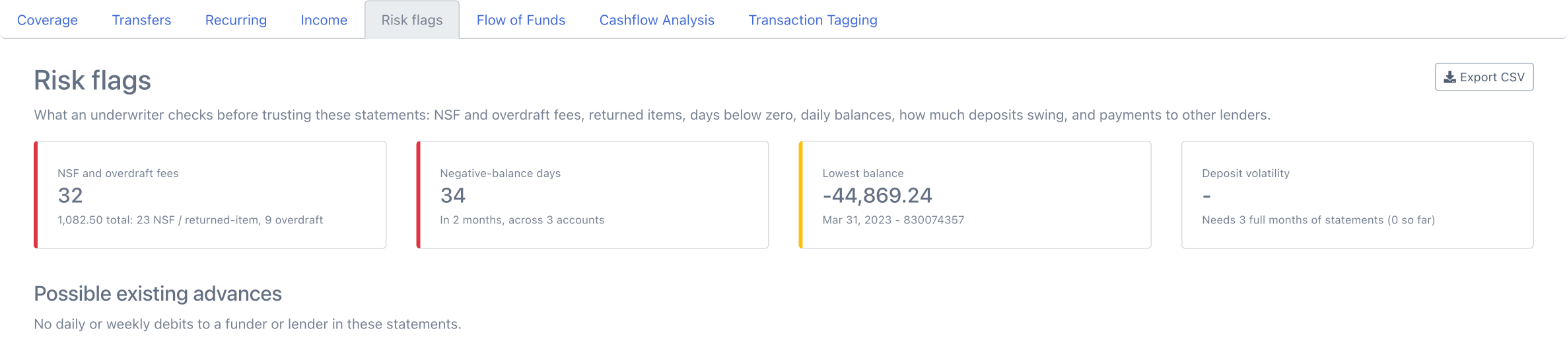
Summary
- NSF and overdraft fees - how many fees were charged and their total, split into NSF / returned-item fees and overdraft fees.
- Negative-balance days - the number of days an account ended below zero, and in how many months. With several accounts, each account's days are added up.
- Lowest balance - the lowest end-of-day balance in the statements, with its date (and account, when there are several).
- Deposit volatility - the coefficient of variation of monthly income, with a band: Steady (25% or less), Variable (up to 50%) or Highly variable (over 50%).
When none of the flags is raised, a No risk flags notice says so.
Possible existing advances
Two kinds of payee are listed: a known merchant cash advance or business lender (OnDeck, Kapitus, BlueVine, Fundbox, Credibly, Libertas, Everest Business Funding, Shopify Capital, PayPal Working Capital, Square Loans and others) that the account paid at least twice, on any schedule; and any payee whose name says funding, capital, advance, lending or loan that is paid on a daily (business-day) or weekly schedule and takes a steady amount each time (within 10% of its usual debit for at least 6 in 10 debits). For each one you see the cadence, the typical debit, its monthly equivalent (daily x 21.7 business days, weekly x 52 / 12), the number of debits, the total, the first and last debit, and any deposit from the same payee (usually the funding itself). A payee whose debits stopped before the end of the statements is marked Stopped and is not part of the monthly total.
Monthly card payments, mortgages, car loans and student loans are not listed: they are not paid daily or weekly, and card issuers and consumer lenders are excluded by name.
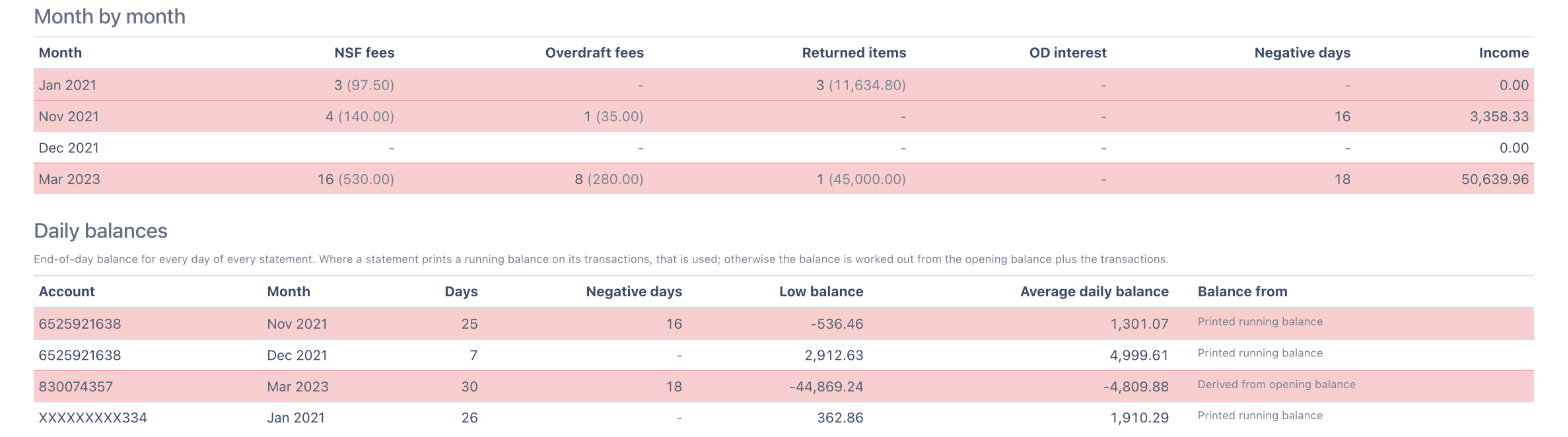
Month by month
One row per calendar month with the NSF fees, overdraft fees, returned items and overdraft interest (count and total), the negative-balance days and the month's income from the Income view. Months with an NSF fee, an overdraft fee, a returned item or a day below zero are highlighted.
Daily balances
One row per account and month: the days covered by statements, the negative days, the low balance, the average daily balance, and where the balance came from:
- Printed running balance - the statement prints a balance on its transaction rows, and that balance is used.
- Derived from opening balance - the statement prints no running balance, so each day's balance is the statement's opening balance plus every transaction up to that day.
- Printed + derived - some days had a printed balance and the rest were worked out from it.
A note under the table tells you when a statement's transactions do not add up to its closing balance (balances worked out from it may be off), when a statement has neither an opening nor a running balance (it is left out), or when a printed running balance did not agree with the amounts and the worked-out balance was used instead.
Credit card accounts have no daily balances here: a card balance is money owed, not money in the account.
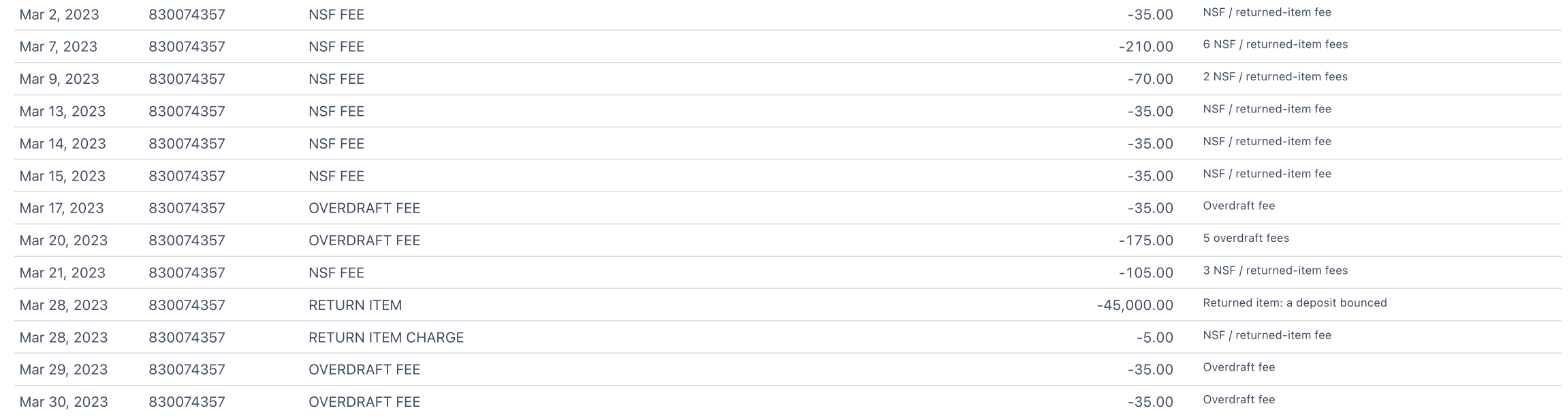
Flagged transactions
Every transaction that raised a flag, with its date, description, amount and what it was flagged as. Fee refunds and reversals are listed too, so you can see when the bank gave a fee back.
Export
Export CSV downloads the whole report: the summary, month by month, daily balances per account and month, possible existing advances, and every flagged transaction. It opens in Excel.
The rules
NSF and returned-item fees
A withdrawal is an NSF / returned-item fee when its description names NSF, non-sufficient or insufficient funds, a returned or unpaid item, check, payment or direct debit, and a fee or charge. For example: NSF FEE, NSF RETURN ITEM FEE, RETURNED ITEM FEE, INSUFFICIENT FUNDS CHARGE, PAID/RETURN ITEM FEE, CHARGE UNPAID ITEM, FEE- POS DECLINED INSUFF FUNDS.
A withdrawal that names NSF or insufficient funds without the word fee is the fee when it is 75.00 or less (banks print WITHDRAWAL DRAFT NSF IN THE AMOUNT $410.00 for a 25.00 fee) and the returned item itself when it is more.
Overdraft fees
A withdrawal that names an overdraft, an overdrawn account, OD, ODP or courtesy pay together with a fee, a charge or a paid item: OVERDRAFT FEE, OVERDRAFT ITEM FEE, OD FEE, OVERDRAFT PD, COURTESY PAY FEE, HONOUR/OVERDRAWN FEE, PD ITEM - OVERDRAFT CHARGE.
Several fees on one row
Some banks post several same-day fees as one row. When a fee amount appears at least twice on an account, a row that is a whole multiple of it counts as that many fees: NSF FEE 210.00 on an account that charges 35.00 counts as six NSF fees.
Overdraft interest and facility fees
Interest on an overdraft and the monthly or facility fee for an arranged overdraft (OVERDRAFT INTEREST, INTEREST ON OVERDRAFT, OD MONTHLY FEE, O/D FACILITY FEE) are shown in their own OD interest column. They mean the account uses an overdraft facility, which is not the same as an item the bank refused to pay, so they are not part of the NSF and overdraft fee count.
Returned items
A deposit that names a returned or unpaid item, check, payment, direct debit or NSF is a payment the account holder made that came back unpaid. A withdrawal that does, and is not a fee, is a deposit that bounced. Merchant chargebacks and descriptions that only mention a transfer are not returned items.
Overdraft protection and fee refunds
A deposit described as an overdraft protection transfer (OVERDRAFT PROTECTION FROM, ODP TRANSFER FROM SAVINGS) is counted as an overdraft protection transfer: money moved in to cover a shortfall. A deposit that refunds, reverses or waives one of the fees above is listed as Fee refunded. Fee rows marked NOT CHARGED are ignored.
Negative-balance days
Each statement period is walked day by day from its start date to its end date. A day's balance is the balance after its last transaction, and a day with no transactions keeps the previous day's balance. A printed running balance is used only when it agrees with the amounts between rows (at least 9 in 10 rows); a misread balance column never produces a false negative day. When statements for one account overlap, each day is counted once.
Deposit volatility
The coefficient of variation is the standard deviation of monthly income divided by its average, using the income the Income view counts (transfers, refunds and loan proceeds left out). Only full calendar months with no missing statement are used, so a partial first or last month does not inflate it. It needs at least 3 such months.
Related
- Income Analysis - average and recurring monthly income from the same statements
- Coverage (Date Gaps) Analysis - find missing statement periods
- Understanding bank statement fraud detection - check the statements for edits
- Advanced Analysis overview