
How To Convert Invoice And Receipts To Excel
Upload invoice or receipt PDFs in DocuClipper, review the extracted vendor, date, and line-item data, then download every invoice in a project as one Excel or CSV file — with control over columns, date format, and the Source PDF Link.
Last updated
To convert invoices or receipts to Excel in DocuClipper, click Add Documents → Invoices/Receipts, drag in your PDFs, review extracted fields (vendor, date, invoice number, total, line items) in the Invoices tab, then click Download from the list and set the Output Format to Excel. DocuClipper builds one consolidated spreadsheet with every invoice in the project.
DocuClipper recommends 300 DPI or higher for scanned documents. Every extracted field is editable inline before export, and Customize Fields lets you choose which columns appear in the .xlsx or .csv.
To learn how to create and manage your projects, see How to Use DocuClipper's New Project-Based Interface.
Step 1: Upload your invoices or receipts
- Click Add Documents in the left sidebar and choose Invoices/Receipts from the dropdown. Or open a project, click Upload, and select Invoices/Receipts.
- Drag in all of your PDFs at once — you can drop dozens of files mixing different vendors and layouts, since extraction is template-free and no per-vendor setup is needed.
- Add tags (optional) and click Import.
Keeping every invoice in one project is what makes a single combined export possible. Separate projects produce separate files.
Notes: DocuClipper recommends 300 DPI or better for scanned documents. Extraction is most accurate on documents that are not distorted, tilted, or faded.
Step 2: Review the extracted data
Once processing completes, open the project and click the Invoices tab. Click any invoice row to open the detail view and review key fields:
- Vendor
- Date and invoice number
- Total amount, subtotal, and tax
- Line items (description, quantity, price)
Edit any field by clicking it. Corrections made here flow into the exported file, so fix anything before you export rather than editing the spreadsheet by hand afterward.
Step 3: Download to Excel or CSV
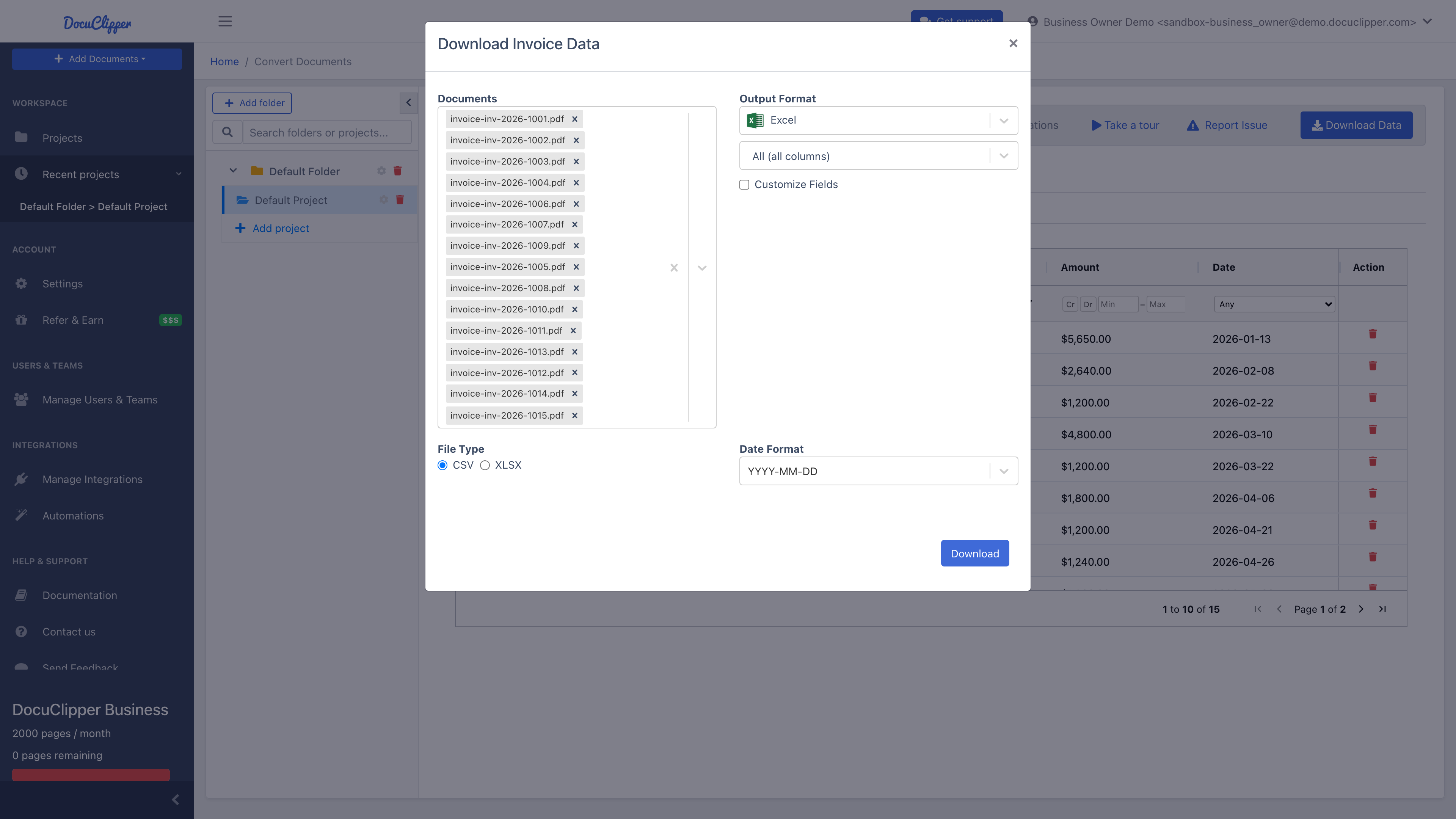
- From the Invoices list, click Download to open the Download Invoice Data modal. Optionally filter the list first — by date, supplier, status, or rule — to control which rows are included.
- Under Documents, confirm which files to include.
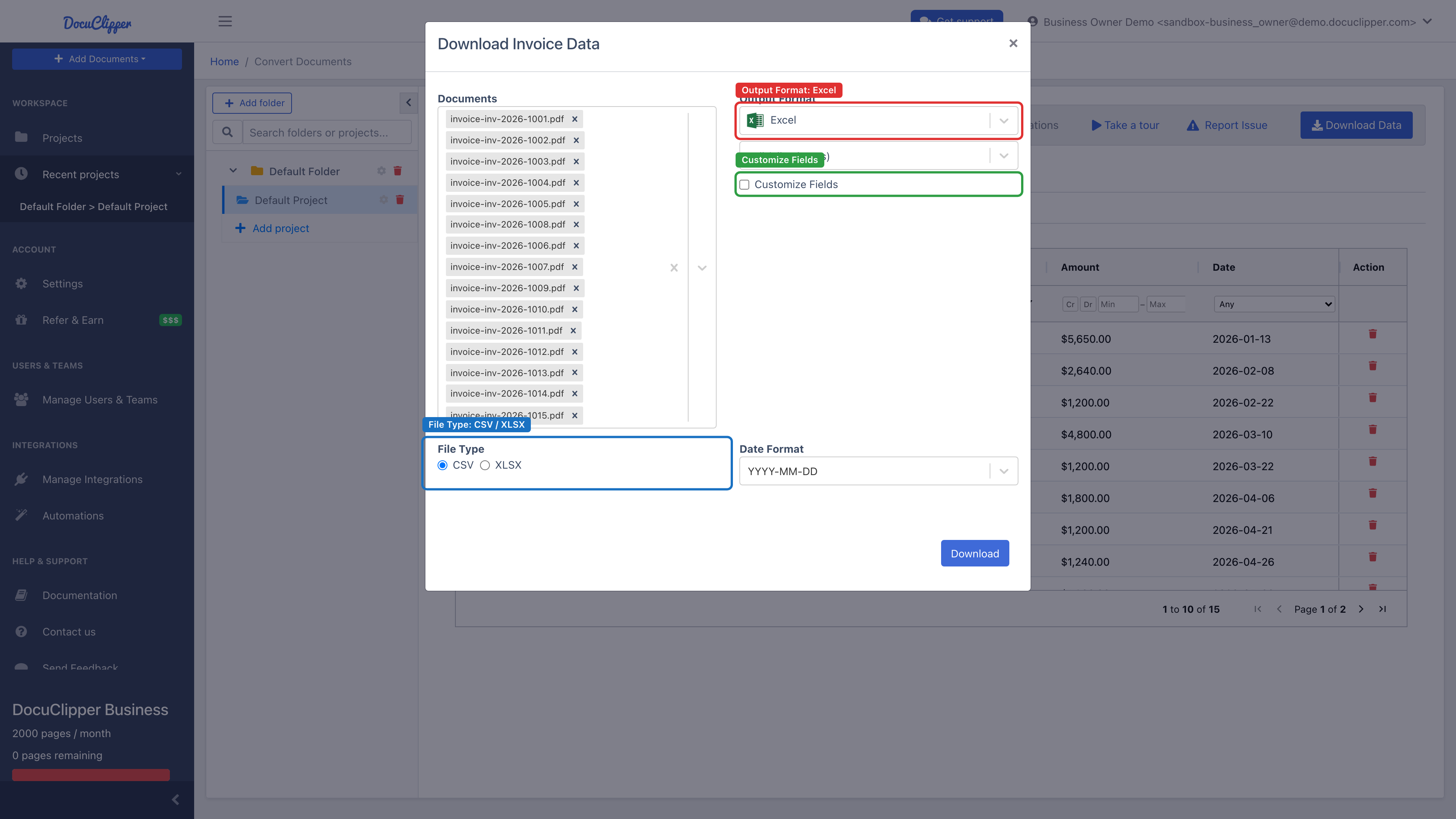
- Set the Output Format to Excel (spreadsheet columns) — or pick one of your saved column sets.
- Choose a File Type — XLSX or CSV — and a Date Format.
- Tick Customize Fields to toggle which columns appear. Defaults cover supplier, invoice number, date, due date, subtotal, tax, and total.
- Check the Preview table, then click Download.
Choose XLSX to open the file directly in Excel, or CSV when you're importing the data into a system with no direct connector (for example, NetSuite).
Downloading to Excel or CSV is separate from syncing to accounting software. For QuickBooks Online, Xero, or QuickBooks Desktop, don't use the spreadsheet download — see Export to QuickBooks, Export Invoices to Xero, and Downloading Invoices and Receipts for those paths.
Get one file for every invoice in the project
Downloading from the Invoices list (not from inside a single invoice) builds one consolidated file containing every invoice in the project. The only thing that changes between formats is how many rows each invoice produces:
| Shape | Each row is | Best for |
|---|---|---|
| One row per invoice | A summary line (vendor, number, date, total, tax) | AP registers, reconciliation, totals |
| One row per line item | Each line item from each invoice | GL coding, spend and item-level analysis |
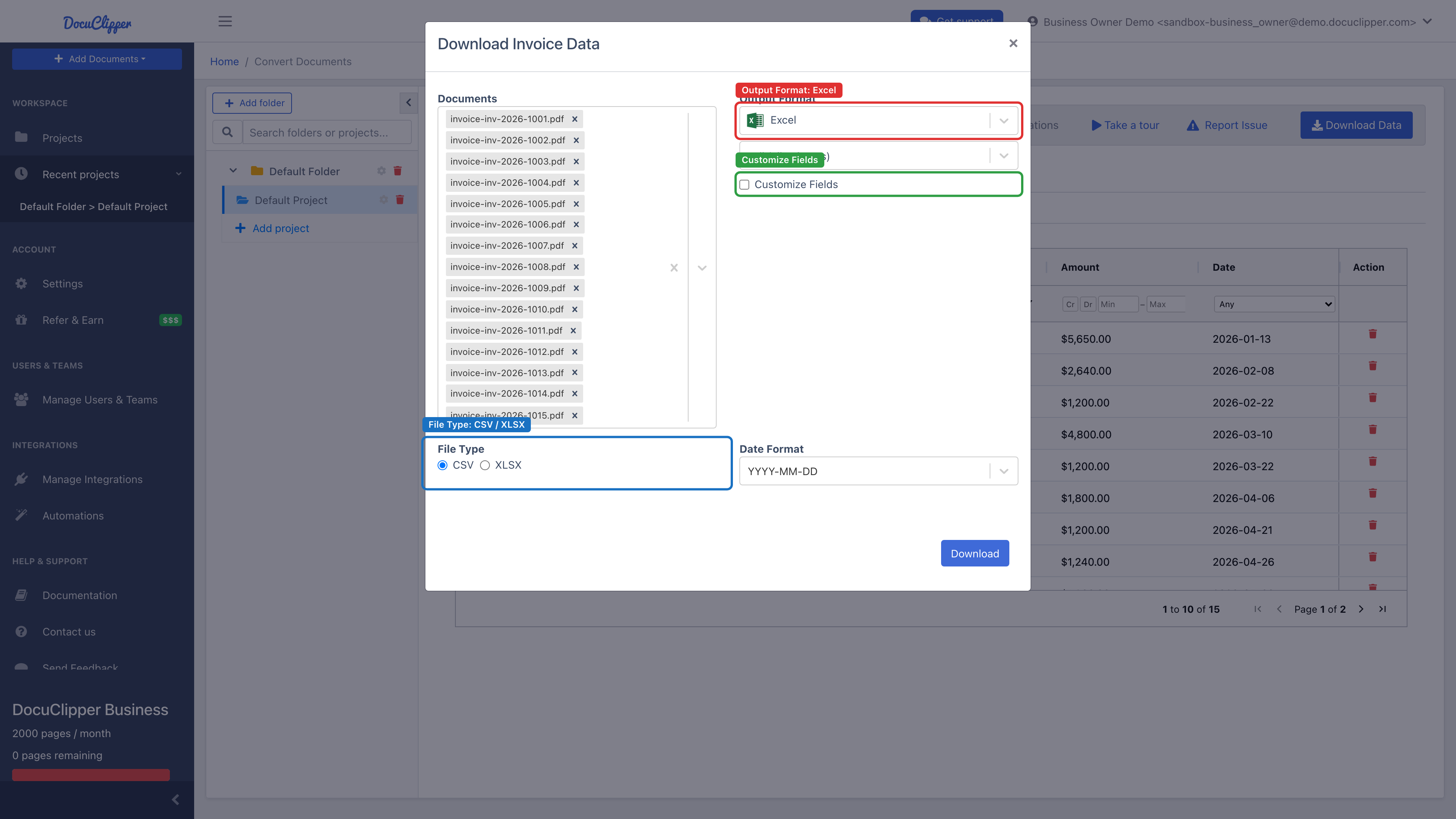
Source PDF Link column
Excel and CSV invoice exports can include a Source PDF Link column — a clickable link on each row that opens that exact invoice's source document in DocuClipper's in-app viewer. It's the fastest way to jump from a spreadsheet row back to the original invoice without digging through files.
- The link points to DocuClipper's invoice viewer and is stable — it doesn't expire. If you click it while signed out, you're sent to log in and then bounced straight to the invoice.
- In Excel the cell is a real hyperlink; in CSV it's the plain URL.
- This column is available for invoice and receipt exports. (Bank-transaction exports don't include a source-PDF link.)
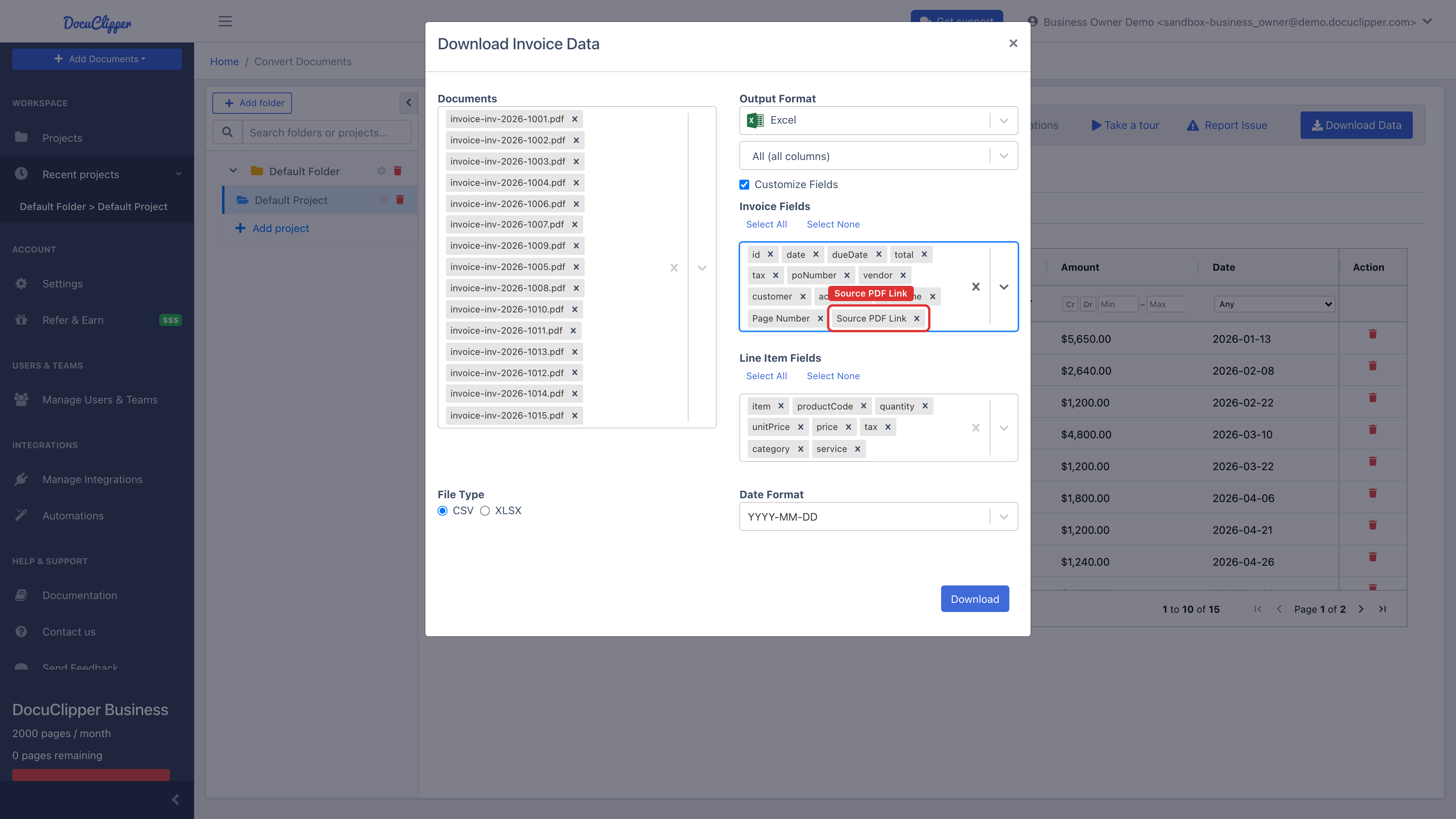
Export only included one invoice
This is the most common bulk-export question, and it's a UI path issue, not a bug. There are two places to download:
- From inside a single invoice (detail view): the file contains only that one invoice. This is correct for that view — it's scoped to the document you opened.
- From the Invoices list: the file contains every invoice in the project.
If your spreadsheet had one invoice when you expected many, you exported from the detail view. Go back to the Invoices list and click Download there.
Tips
- If you only want invoices that passed your approval workflow, filter by Status: Approved before downloading.
- Rerunning a download is safe — DocuClipper doesn't modify any records on export.
- Custom columns you add (rule-driven GL codes, project tags) appear as additional spreadsheet columns automatically.
Need Help?
If you encounter any issues, feel free to reach out via support@docuclipper.com or check our full Help Center.
FAQs
How do I convert invoices or receipts to Excel?
Upload the PDFs through Add Documents → Invoices/Receipts. Once processing finishes, open the Invoices tab, review the extracted fields, then click Download from the list and set the Output Format to Excel.
How do I export all my invoices to one spreadsheet?
Upload every invoice into one project, open the Invoices tab, then click Download from the list and choose Excel or CSV. DocuClipper combines all invoices in the project into a single file.
Why did my export only include one invoice?
You downloaded from the single-invoice detail view, which is scoped to one document. Return to the Invoices list and click Download from there to get every invoice in one file.
What fields does DocuClipper extract from an invoice?
Vendor, invoice date, invoice number, subtotal, tax, total amount, and individual line items including description, quantity, and price. Each field is editable in the detail view if anything needs correction.
Can I choose which columns appear in the Excel export?
Yes. Use Customize Fields in the Download Invoice Data modal to toggle which columns to include. Defaults cover supplier, invoice number, date, due date, subtotal, tax, and total.
Can I get each line item on its own row?
Yes. The export can produce one row per invoice (a summary line) or one row per line item, depending on the field options you choose in the download dialog.
Should I use Excel or CSV?
Use XLSX to open and read the file directly in Excel. Use CSV when you're importing into a system with no direct connector, such as NetSuite. For QuickBooks or Xero, sync directly instead of importing a spreadsheet.
What scan quality should I use for receipts?
300 DPI or higher. Extraction works best on documents that are not distorted, tilted, or faded.
Can I edit extracted data before downloading?
Yes. Click any field in the invoice detail view to edit it inline. Changes are saved before you export.