
Import Bank Statement Transactions into QuickBooks Desktop (IIF)
Export an IIF file from DocuClipper and import it into QuickBooks Desktop. Includes how to validate against your QuickBooks Chart of Accounts and fix the 'Account Name does not exist' error.
Last updated
To import a DocuClipper bank statement into QuickBooks Desktop, export the project as a QuickBooks Desktop IIF file (with Source Account and Destination Account set against your uploaded Chart of Accounts), then in QBD use File → Utilities → Import → IIF Files to load it.
Uploading your Chart of Accounts to the DocuClipper project first lets DocuClipper validate every account name in the IIF before download, which prevents the most common "Account Name does not exist" error on import.
If you have not yet uploaded your QuickBooks Chart of Accounts (COA) to your DocuClipper project, do that first. See How to export your Chart of Accounts from QuickBooks Desktop. Once your COA is uploaded under Project Settings → QuickBooks Desktop, DocuClipper validates every IIF download against it and flags account name mismatches before you ever open QuickBooks.
What do I need before importing an IIF into QuickBooks Desktop?
- A QuickBooks Desktop company file (Pro, Premier, Enterprise, or Mac).
- A DocuClipper project with at least one extracted bank statement.
- (Recommended) Your QBD Chart of Accounts uploaded once per project. See the COA export guide.
Step 1. Export the IIF from DocuClipper
-
Open the project that contains your extracted statements.
-
In the left sidebar, click Add Documents and confirm your bank statements have finished processing. (Skip the first-time card picker if you already have documents in the project. Use the Add Documents dropdown for every subsequent upload.)
-
Above the transactions table, click Download Data.
-
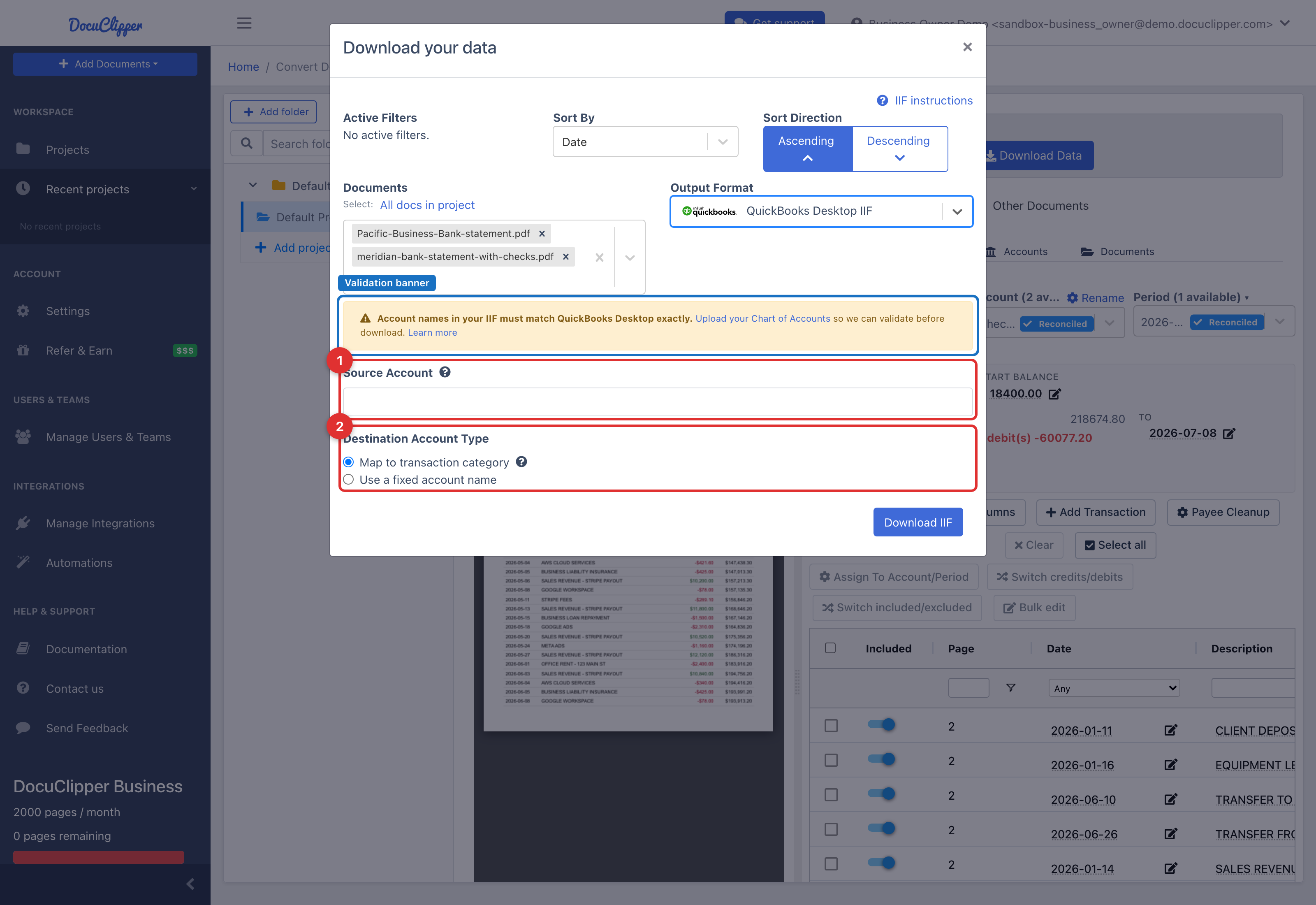
In the Output Format dropdown, choose QuickBooks Desktop IIF.
-
At the top of the IIF panel you will see a banner. If no COA is uploaded, a warning banner reminds you that account names must match QuickBooks Desktop exactly and links you to upload your Chart of Accounts. If a COA is uploaded, an info banner reads "Validating against N accounts in your QuickBooks Desktop Chart of Accounts."
-
Fill in the export fields:
Source Account (required)
- The account the transactions came from in QuickBooks, for example
Checking AccountorWells Fargo 1234. - If your COA is uploaded, pick it from the dropdown of your Chart of Accounts. If no COA is uploaded, the field is a free-text box — type the account name exactly, including spaces and capitalization.
Destination Account Type (choose one)
- Map to transaction category (recommended). Each transaction's category in DocuClipper becomes the destination account on the IIF split. This is the typical workflow if you have already categorized your transactions. With a COA uploaded, any categories that don't match an account name are listed inline so you can fix them first.
- Use a fixed account name. All transactions post to one account. A Destination Account field appears — a dropdown from your Chart of Accounts if a COA is uploaded, otherwise a free-text box.
- The account the transactions came from in QuickBooks, for example
-
Click Download IIF.
If your project has a Chart of Accounts uploaded, DocuClipper validates every Source, Destination, and category name against it before producing the file. Any mismatches are listed inline so you can fix them in DocuClipper rather than discover them in QuickBooks.
Even if you skip the upload, the downloaded IIF file includes a ; WARNING: comment block at the very top listing every account name that DocuClipper could not validate. Open the IIF in any text editor before importing so you know what QuickBooks is about to reject.
Step 2. Import the IIF into QuickBooks Desktop
- Open your company file in QuickBooks Desktop.
- Go to File → Utilities → Import → IIF Files.
- Click Import IIF and select the
.iiffile you downloaded. - QuickBooks shows a summary of the import. Click Done.
- Open Banking → Use Register, select the source account, and confirm the new transactions appear with the correct dates, amounts, and categories.
The most common error
If your account names do not match, QuickBooks shows this exact error:
Some of your records have errors. Click View errors to fix them.
The Account Name on a distribution does not exist in Quickbooks.
This means one or more category names, the Source Account, or the Destination Account in the IIF do not match an account in your QuickBooks Chart of Accounts.
QBD account name matching is strict:
- Case-sensitive:
Office Suppliesis not the same asoffice supplies. - Punctuation-sensitive:
Meals & Entertainmentis not the same asMeals and Entertainment. - Whitespace-sensitive: trailing spaces and double spaces count.
- Sub-account paths must match in full, separated by colons. For example
Auto:Fuel, notFuel.
How to fix it
- In DocuClipper, open the project, open Project Settings, and click the QuickBooks Desktop tab.
- Upload your QuickBooks Desktop COA. You can either upload the
.iifexport directly, or paste the!ACCNTblock (or one account name per line) into the textarea on that tab. See How to export your Chart of Accounts from QuickBooks Desktop for the exact steps inside QBD. - Return to your transactions and re-run the IIF download. DocuClipper now compares every account name against your uploaded COA and shows a list of mismatches inline. Fix each mismatch by either:
- Renaming the category in DocuClipper to match QBD, or
- Adding the missing account in QuickBooks and re-uploading the COA.
- Re-export the IIF and re-import in QuickBooks. The error should be gone.
You only need to upload the Chart of Accounts once per project. DocuClipper reuses it for every future IIF export in that project.
Other common issues
- Duplicate transactions. IIF import does not deduplicate. Importing the same file twice creates duplicates. If this happens, delete the extra batch in QuickBooks.
- Dates off by one. Check that your DocuClipper date format matches your QuickBooks locale.
- A new account showed up in my chart of accounts. That category did not match an existing QBD account and QuickBooks created it on import. Rename it inside QBD or upload your COA in DocuClipper to prevent this on future imports.
Tips
- Back up your QuickBooks company file before any IIF import. Imports cannot be undone in bulk.
- Always import into a dedicated source account so you can filter and review the batch later.
- For a more modern alternative that supports automatic matching, see QuickBooks Desktop Web Connect (.QBO).
FAQs
How do I import an IIF file into QuickBooks Desktop?
In QuickBooks Desktop, open your company file and go to File, Utilities, Import, IIF Files. Click Import IIF, select the .iif file from DocuClipper, then open Banking, Use Register on the source account to confirm the transactions posted correctly.
Why does QuickBooks show "The Account Name on a distribution does not exist"?
One or more account names in the IIF do not match a name in your QuickBooks chart of accounts. Matching is case-, punctuation-, and whitespace-sensitive, and sub-accounts must use the full colon-separated path like Auto:Fuel.
How do I prevent the account name error before importing?
Upload your QuickBooks Desktop Chart of Accounts once per project under Project Settings, QuickBooks Desktop. DocuClipper then validates every Source, Destination, and category name against your COA and flags mismatches before you download the IIF.
Does IIF import deduplicate transactions?
No. Importing the same IIF file twice creates duplicate entries. If it happens, delete the extra batch inside QuickBooks.
Can I undo an IIF import in QuickBooks Desktop?
Not in bulk. Always back up your company file before importing so you can restore from the backup if needed.
What is the difference between IIF and Web Connect for QuickBooks Desktop?
IIF maps each transaction's category to a destination account on import, which is useful if you have already categorized in DocuClipper. Web Connect (.qbo) supports automatic vendor matching and rename rules in the bank feeds queue instead.