
Import Bank Statement Transactions into Xero
Export bank statement transactions from DocuClipper as a Xero-ready CSV and import them into a Xero bank account.
Last updated
DocuClipper moves transactions from a converted bank statement into Xero two ways:
- Xero CSV — download a Xero-ready CSV and import it into a bank account. No column remapping required.
- Xero Direct Sync — push transactions straight into a Xero bank account over the Xero API, no file download. See Option B below.
Step 1: Download the Xero CSV
- Open the project containing your converted bank statement.
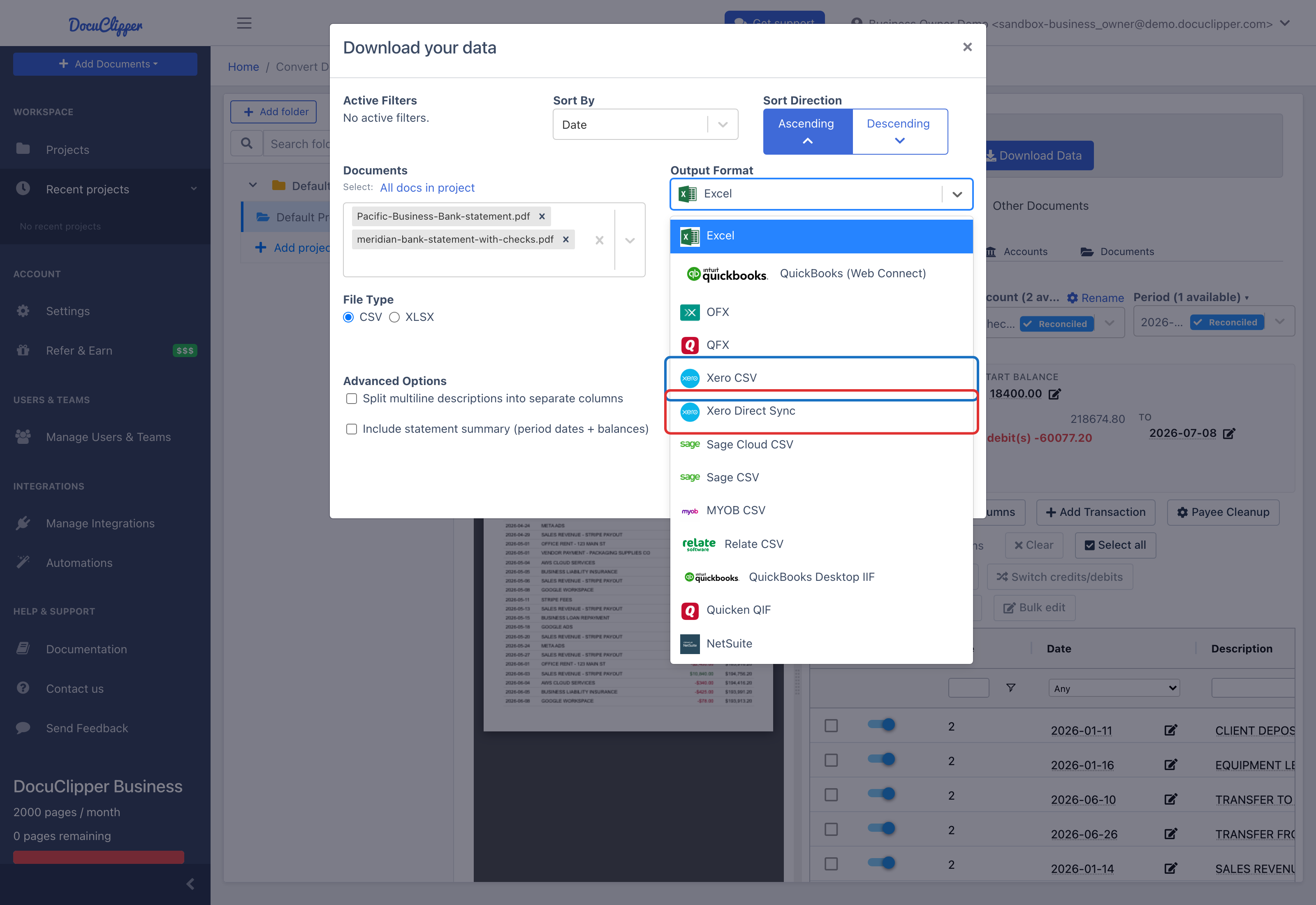
- Click Download Data (above the Summary of Reconciliation).
- Under Output Format, choose Xero CSV.
- The default columns (Date, Description, Amount) match what Xero expects. Leave them as-is unless you have a specific reason to change.
- Click Download.
Step 2: Import into Xero
- In Xero, go to Accounting → Bank accounts → select the account you want to import into.
- Click Manage account → Import a statement.
- Upload the CSV from step 1.
- Xero shows a column-mapping preview. Since this is a Xero-format CSV, all columns are pre-mapped. Click Save.
- Xero imports the transactions into the bank's Reconcile tab.
Step 3: Reconcile in Xero
Imported transactions appear in the Reconcile tab with green OK buttons wherever Xero can match them to an existing contact or rule. Anything unmatched gets a Create button where you can code it on the fly.
Option B: Xero Direct Sync
If you'd rather skip the CSV entirely, push transactions straight into a Xero bank account over the Xero API.
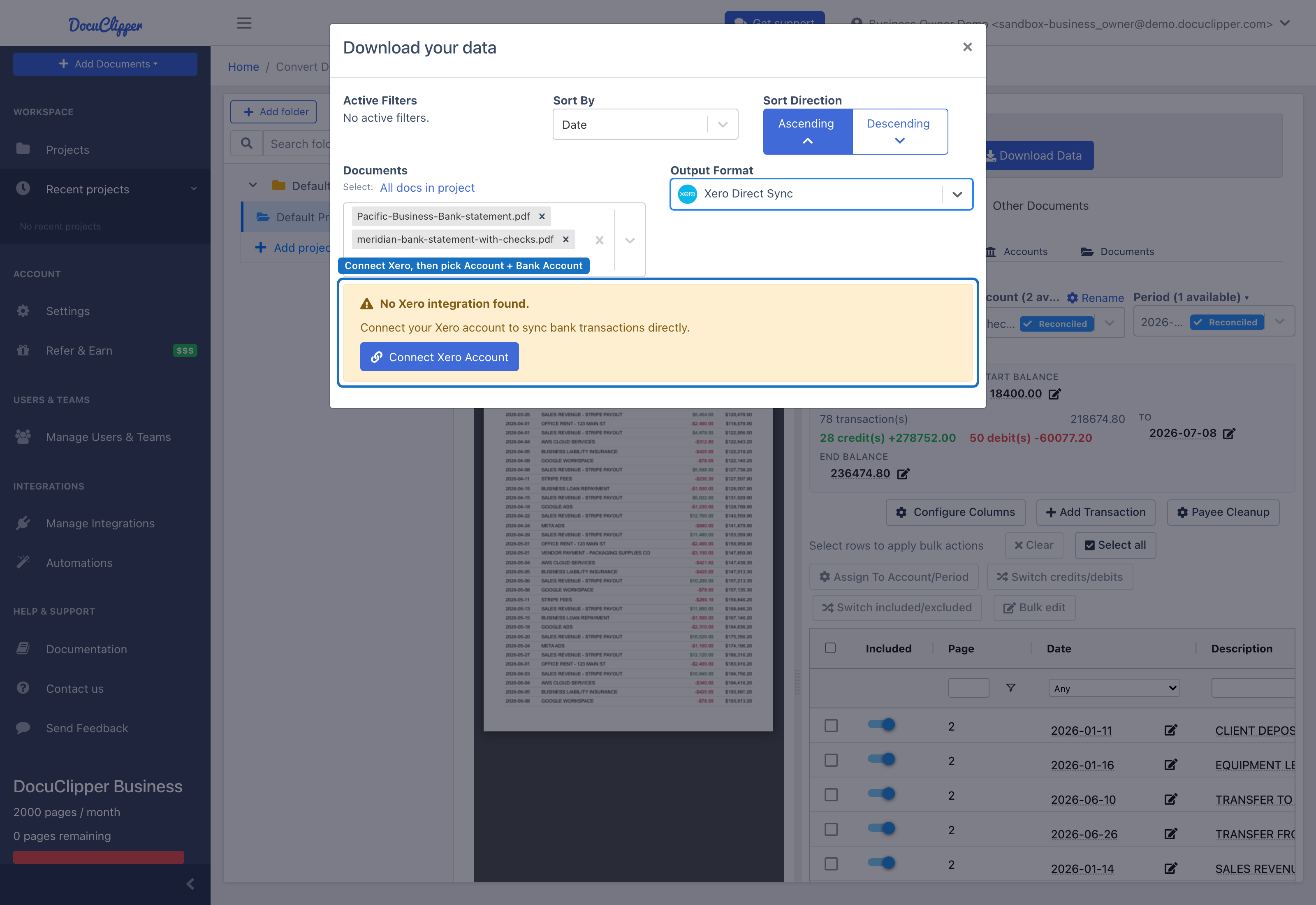
- Open the project, click Download Data, and under Output Format choose Xero Direct Sync.
- If you haven't connected Xero yet, click Connect Xero Account and authorize DocuClipper. You'll return to this panel afterward.
- Pick the Xero Account (organization) and the Destination Bank Account to sync into.
- Click Sync to Xero. DocuClipper reports how many transactions were found, synced, and already present, plus any errors.
Direct Sync skips already-synced transactions, so re-running the same period is safe. Nothing downloads to your computer.
Date format tips
Xero respects the date format set on your organization. If Xero flags dates as invalid:
- Make sure your DocuClipper date format matches your Xero org. See Customize Date Format.
- For UK / AU / NZ Xero orgs, use DD/MM/YYYY. For US orgs, use MM/DD/YYYY.
Duplicates
Xero deduplicates imports based on date, amount, and reference. Re-importing the same period is safe; Xero will skip transactions it already has.
Tips
- Want to skip manual CSV uploads? Use Xero Direct Sync to push transactions over the API, or the Direct QuickBooks integration for the equivalent QBO workflow.
- For invoices and bills (not bank transactions), use Export Invoices to Xero instead.
FAQs
Should I use Xero CSV or Xero Direct Sync?
Direct Sync is simpler — it pushes transactions over the Xero API with no file to download or import. Choose the CSV if you'd rather review the file first, or if you're not connecting DocuClipper to Xero.
Do I have to map columns when importing the CSV into Xero?
No. The Xero CSV already uses the columns Xero expects (Date, Description, Amount), so the mapping preview comes through pre-filled.
Is it safe to re-run Direct Sync on the same period?
Yes. Direct Sync skips transactions that are already present, so re-running won't create duplicates.
Can I sync to more than one Xero organization?
Yes. Pick the Xero Account (organization) and the destination bank account each time you sync. See Connecting multiple QuickBooks and Xero accounts.
Where do the transactions land in Xero?
In the bank account's Reconcile tab, with green OK buttons where Xero can match them to an existing contact or rule, and Create where it can't.